
Too Soon v. The Unveiling
presented by

MARCH 12, 2026 • OPENING ROUND
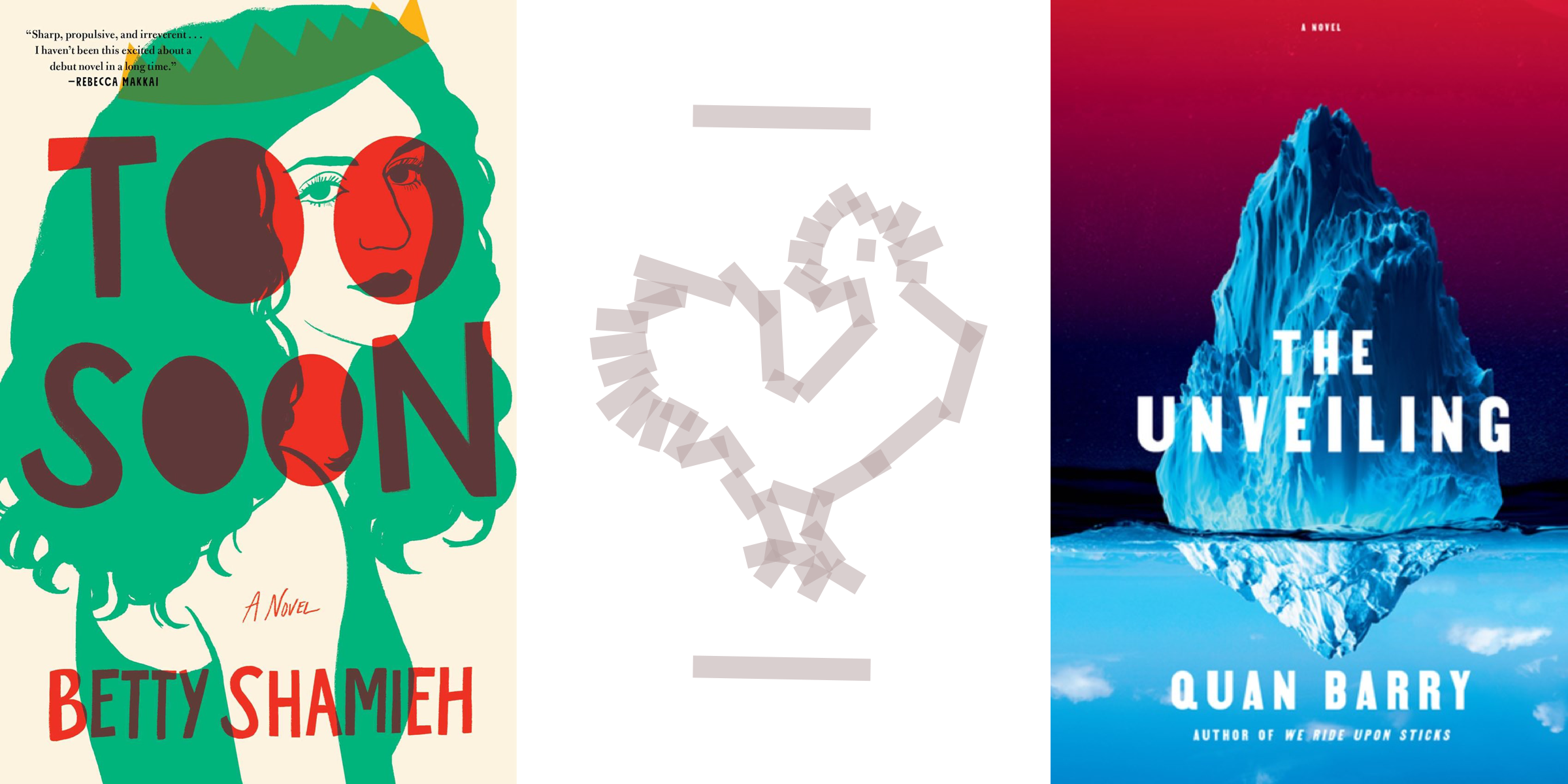
Too Soon
v. The Unveiling
Judged by Sarah McCarry
Sarah McCarry is a writer. Her newest novel, Possession Island, is forthcoming in 2026. Known connections to this year’s contenders: None. / sarahmccarry.net, Bluesky, Instagram
I’m a writer who reads almost exclusively for pleasure, and what brings me pleasure is rarely a vigorous moral lesson or a novel undertaken with the desire to instruct. I like the capacious and the unruly; the weird; the plotty and its opposite, the entirely vibes-based; the rampant deployment of the semicolon. I like books that spill over, that put out tendrils, that revel in unrepentant maximalism; I like a hot, compelling mess a lot more than I like somebody with their button-down tucked in. This is books, not church.
I also really, really like horror novels and books about Antarctica, so it was with quite some anticipation that I opened up Quan Barry’s Antarctic horror novel The Unveiling. Striker is a 40-year-old Black film scout sent on a luxury Antarctic cruise to photograph potential locations for a big-budget, Oscar-bait Shackleton biopic. (The Anglo-Irish explorer Sir Ernest Shackleton is most famous for his disastrous Trans-Antarctic expedition, a thoroughly unsuccessful attempt to make the first land crossing of Antarctica. While Shackleton’s human colleagues all survived, the sled dogs were eaten by the starving expedition members, and Shackleton shot the ship’s cat, Mrs. Chippy, an act for which neither I nor the ship’s carpenter, Harry McNish, ever forgave him.) Striker’s companions are wealthy, mostly white tourists thirsting for a zesty Instagram grid, but their first off-board Antarctic adventure—a Christmas Eve kayak paddle—begins with an albatross flying into a tourist’s $15,000 camera lens. The bird is gruesomely injured, and a crew member breaks its neck. “Someone was going to pay for this,” Striker observes. “The bad luck had to fall somewhere.” It does: A mysterious disaster descends upon the kayak trip, and Striker is stranded with a handful of guests on an Antarctic peninsula that is also home to an old expedition hut packed full of restless undead explorers—or, in other words, mostly white tourists thirsting for a zesty polar exploration narrative, albeit some years before the Instagram grid was an option.
Striker, we learn quickly, is an unreliable narrator; just how unreliable becomes apparent as the novel proceeds, as we realize the events she is reporting may not be happening as she reports them—or at all. Another character observes that the medication she runs out of—used, Striker tells us, to alleviate the migraines that transform her into the dissociated alternate self she calls Dark Striker—is in fact used to treat schizophrenia. As horrific fates may or may not be picking off the kayak disaster survivors one by one, Striker’s past overtakes her present in the relentless Antarctic light. Also, this is a horror novel, so everyone involved has a lot of personal problems.
Betty Shamieh’s Too Soon follows the stories of three related women: 35-year-old Palestinian American Arabella Hajjar, a New York theater director in 2012; her grandmother Zoya, who is forced to flee Jaffa for the United States with her family during the 1948 Nakba; and Naya, Zoya’s daughter and Arabella’s mother, who grows up in a primarily Black neighborhood in Detroit in the 1970s. Arabella, the novel’s primary narrator, is experiencing a crisis in her career and her personal life when she’s offered the opportunity to direct an experimental gender-bent production of Hamlet in the West Bank. (I can’t not acknowledge here the almost certainly coincidental but nevertheless uncanny overlap with Isabella Hammad’s masterpiece Enter Ghost, in which a 38-year-old British Palestinian actress experiencing a crisis in her career and personal life travels to visit her sister in Haifa and is cast as Gertrude in an experimental production of Hamlet in the West Bank. However, these are very different novels, and Too Soon is more directly interested in Arabella’s romantic life and that of her mother and grandmother than in the mechanics of her Hamlet.)
FROM OUR SPONSOR

Naya and Zoya are determined to set Arabella up with Aziz, a noble and ravishingly handsome Palestinian American doctor doing a volunteer turn in Gaza, who offers her the ancestor-approved prospect of being a good Palestinian and producing Palestinian babies. But Arabella can’t get over her unrequited love for Yoav, an aloof and ravishingly handsome Israeli American lighting designer she’s known since college. Also, this is a romantic comedy, so everyone involved has a lot of personal problems.
Both novels employ a wry, caustic voice to great effect; Arabella and Striker are each prone to gallows humor, understandably exhausted by their own generational trauma and by white liberal expectations of how they will perform grief, marginalization, and supplication. “But thankfully,” Arabella tells us in Too Soon’s opening pages, describing an immediately post-Sept. 11 public theater gathering:
…that liberal crowd was careful. Measured. They even outdid themselves in their estimation of how much Arab blood was on American hands, spouting facts and figures I was not astute enough to keep in my head. Or rather did not have the inclination to do so. […] For fuck’s sake, I’m a theatre director, specializing in postmodern interpretations of Shakespeare.
And both novels confront the afterlives and hauntings (literally, in the case of The Unveiling) of trauma. Striker, we learn eventually, is a transracial adoptee, raised with her sister from young children by a well-intentioned but ill-equipped white family who navigated cultural differences by showing the girls The Wiz on a loop on the recommendation of a therapist. Arabella’s family has been forced from the land they lived on for centuries by Israeli occupiers. Involuntary displacement is the rupture at the heart of both novels, though Shamieh and Barry explore its repercussions in profoundly different ways.
But both Arabella and Striker are determinedly unruly subjects, refusing to conform to the stifling demands of the trauma plot so beloved by post-2020 white liberal readers—and publishers—eager to confuse guilt for meaningful political action. When it’s Striker’s turn to introduce herself to her shipmates, she feels:
…a sudden dip in the temperature… was it her imagination, or were the adults leaning in, eager to hear her every word? This was a new phenomenon Striker had noticed ever since 2020 when pandemonium broke out on the streets. A certain breed of white people attempting to make space. Acting like you had their ear. Like they actually cared what you had to say. […] desperate to convey their message: Dear Human of Color, please know I am your friend.
After an unsuccessful therapy session with “a pert blonde who bore a resemblance to a young Camilla Parker Bowles,” Arabella observes sardonically, “I wonder if [my therapist’s] analysis of me was colored by her own discomfort with facing an angry Palestinian. We’re much more manageable when we are sad.”
I really wanted to love both of these books, whose narrators are characters after my own heart, and whose plots seem tailor-made for my desires as a reader. Striker and Arabella are both funny, complex, and formidable narrators, deliciously resistant to serving as emblematic representations of nobly downtrodden marginalization for audiences who prefer legible narratives of suffering (for the protagonist) and redemption (for the reader).
But neither novel quite reached me. The Unveiling’s unwillingness to commit to a shared reality was distancing for me rather than intriguing; by the end of the novel, I found myself disinvested in its outcome. And Too Soon felt undercooked in places—Naya’s and Zoya’s narratives are much less fleshed out than Arabella’s, and I wanted either more from them or more of Arabella’s relationship to her work, which she tells us is important to her but never fully explores. I struggled with which book to advance: I’d rather read an ambitious but flawed book than a polished but uninteresting one, and there’s much to recommend both novels. Ultimately, although I didn’t go the distance with Striker, I did find The Unveiling more formally inventive and fully realized in its vision. Safe return doubtful it is! Especially if you’re the cat.
Advancing:
The Unveiling
Match Commentary
with Meave Gallagher and Alana Mohamed
Alana Mohamed: Hello, Meave! We’re back at it again. May I say, woof. I’m glad to see The Unveiling make it through, but it’s hard to call this a victory. I do agree that in the end “I’d rather read an ambitious but flawed book than a polished but uninteresting one,” but is she saying Too Soon was uninteresting? Can something be polished yet undercooked?
Meave Gallagher: I think those are mixed metaphors. Something both polished and undercooked—an apple that hasn’t been in the pressure cooker long enough to mash for sauce? It’s funny, for all the quotes, I didn’t really get a sense of either book. For example, I thought they shared a sense of foreboding throughout every narrative; neither allowed the reader to relax, like you were constantly waiting for the horror, or the next horror, to come. I wish Judge McCarry had mentioned that.
Alana: There’s a lot of attention paid to the tone our protagonists take. They are “prone to gallows humor,” “determinedly unruly subjects,” “formidable narrators.” I don’t know if you felt the same way, but reading Too Soon I got to a love-to-hate place with Arabella—I found her annoying, but came to appreciate how human she was. The writing in The Unveiling was so funny and weird and sharp, though, that I kind of immediately accepted Striker’s cynicism and the world it brought me into.
Meave: Oh, same. Arabella seemed to consciously make herself unlikable a lot of the time, which made her attempts to be likable, such as in the displaced persons camp—isn’t it so fucked up that displaced persons camps in Palestine are so established some of them are (or were, speaking of gallows humor 🙃) indistinguishable from towns or villages?—where her lead actress lives, or with the elders in her grandparents’ village, so full of pathos? I liked Arabella more when she was sincere, regardless of the emotions she was expressing. Whereas Striker seemed sincere from the jump, so she was easier to empathize with. Also her reasons for distrusting her fellow travelers seemed much more understandable than Arabella’s reasons for never talking to her mother, for example.
Alana: I can’t lie, I judged Arabella a lot. But I was also forced to ask myself, “Who am I to judge her?”
Meave: Shamieh wrote a real human. And I think it’s fair to hold Arabella to a high standard. But you could argue that at least some of her behavior is her reaction to a world that was built to reject her. I don’t know.
Alana: Judge McCarry has a lot to say about what ties Arabella and Striker together, but I would have loved to hear more about how the historical romance elements of Too Soon measured up to the experimental horror elements of The Unveiling. And I certainly wanted to hear more about the things that didn’t work—for example, The Unveiling’s treatment of mental health gave me pause, though I know horror is often playing with reality, perception, and such.
Meave: Oh boy, did that twist about Striker “not taking her medication” / “it’s used to treat schizophrenia” irritate me. Barry did allow her that little out of “It’s also used to treat migraines”—lots of people are prescribed medications for their off-label uses, such as me, for one. Actual untreated schizophrenia is no small thing: The longer it’s left untreated, the more it damages your brain, making it even harder to treat, so insinuating that Striker doesn’t regularly take her medication for schizophrenia while also having a successful career as a film location scout didn’t make sense to me. The novel would’ve worked fine without it. The other Striker reveal would’ve worked fine without it.
Alana: I couldn’t tell if it was Barry leaning on or playing with horror tropes. I did ultimately enjoy both of our flawed narrators. Did our judge? Despite them “refusing to conform to the stifling demands of the trauma plot so beloved by post-2020 white liberal readers,” it does seem like Judge McCarry felt preached at.
Meave: And resented it! I got judgmental vibes from this judgment.
Alana: Certainly! She wasn’t specific, but her judgment left me with the impression that more than being weird or plotty or unruly, the defining trait of these novels was their “desire to instruct.” Both characters had a lot of critical things to say, but neither novel had a shirt-tucked-in type of vibe to me. And I didn’t feel like I was being lectured at. Both were heavy on exposition, though, and I think I had more of a stomach for it in The Unveiling.
Meave: LMAO I had to read The Unveiling with breaks between chapters because I couldn’t stomach the gore. But no, I didn’t feel lectured at so much. I was just into the stories. Not always enjoying them, though was the reader meant to feel comfy-cozy in either one? No! Both are in my top 10 of this year’s Tournament.
Alana: Yes, there’s something kind of great about how uncomfortable I felt in both of them—for different reasons—and yet how compelled I was to care and to read on. I saw Too Soon frequently compared to Sex and the City in reviews, which I think highlights some fun parts of the novel—I mean, it opens with an almost-threesome with two actors.
Meave: I only check reviews these days to make sure I’m not about to read propaganda, so I did not know this, and it seems wild to me. How is it anything like SatC? I try not to resort to italics, but that comparison makes me feel like I’m living in an alternate reality.
Alana: I think that line might come from Shamieh herself! It’s clear she wants to explore romance and desire amid different cultural and political conditions. Was it walking the line between fun rom-com and historical context for you? Judge McCarry wanted more of the mother and grandmother—I felt their parts were most heavy on exposition, but I see why she would want more from them.
Meave: I could’ve spent more time with Arabella’s mother and grandmother; I wanted to know more about them as people in their lives, not only the events around them. I was less interested in the non-Striker Unveiling characters—definitely didn’t need the transracially adopted, possibly-and-if-so-not-super-compassionately-written autistic child with the rat. Please, what was happening with that child.
Alana: Lucy! Her character was the first to give me pause re: mental health. But I agree with you that I was most interested in Striker, probably because so much of the story is of her experience of other characters. Shamieh clearly thinks Arabella’s mother and grandmother are important to her story, but it seems like her heart is with Arabella most of all. Side note: I feel so bad that Too Soon keeps getting compared to Enter Ghost. They are such different books!
Meave: I have not read Enter Ghost (yet), but based on the publisher’s description, I must agree if for no other reason that Isabella Hammad is writing from the British Palestinian diaspora, and Betty Shamieh is writing from the US Palestinian diaspora, and those experiences are going to be different enough. To what end are we pointing out the similarities?
Alana: Arabella would certainly rebuke the comparison. My brain is now melting so perhaps it’s time to say goodbye!
Meave: Are you sure you’re not trapped in the Antarctic?
The merch table is open
Your purchases help support the Tournament of Books—plus, get 50% off all items when you become a Sustaining Member.





Wear your allegiance to literary bloodsport with pride. Plus, receive a 50% discount on this item and everything in our store when you become a Sustaining Member.
Unisex fit / soft and lightweight / 100% combed and ring-spun cotton (heather colors contain polyester)