The Wilderness v. Metallic Realms
presented by

MARCH 11, 2026 • OPENING ROUND
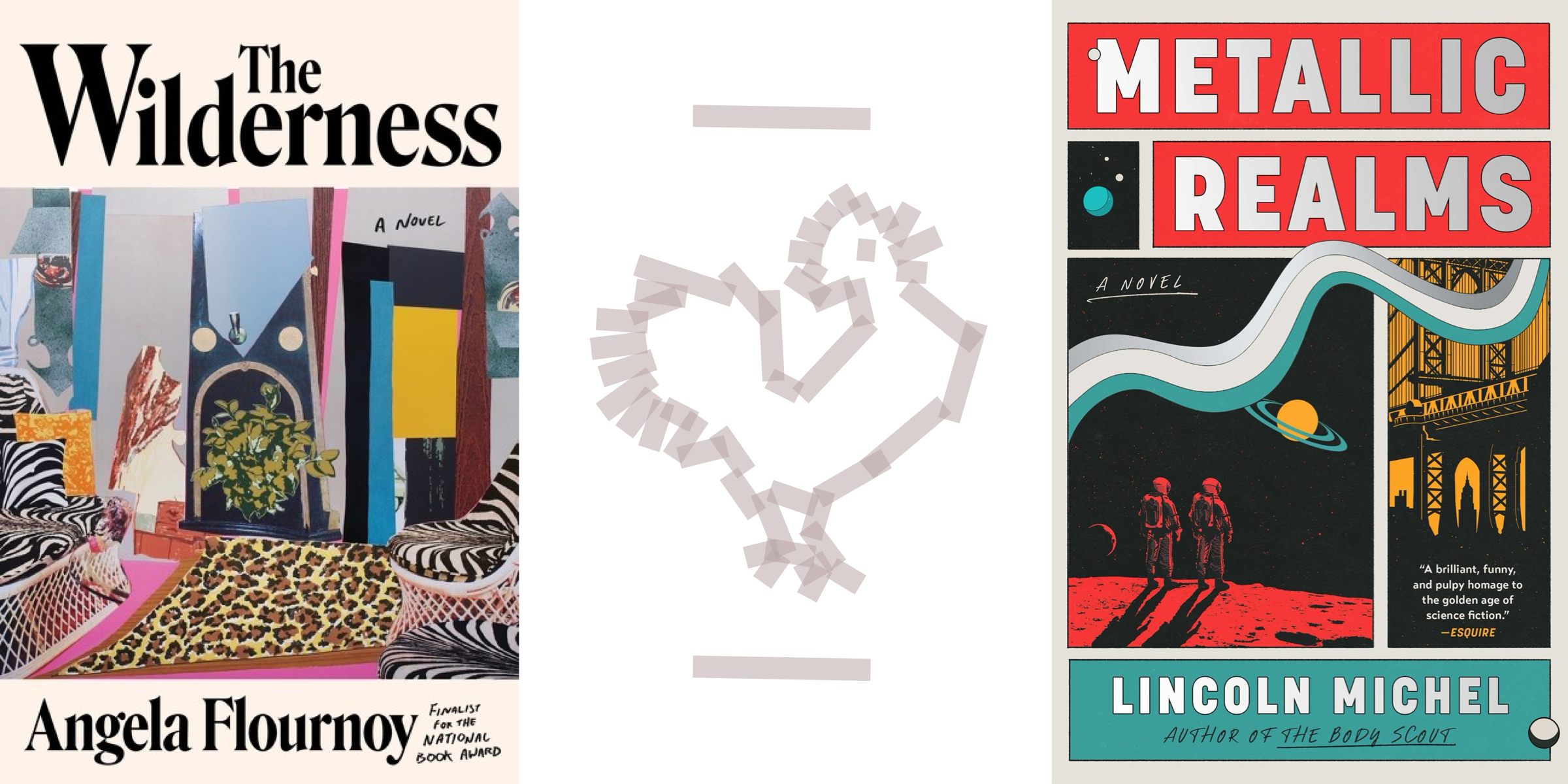
The Wilderness
v. Metallic Realms
Judged by Sarah Anjum Bari
Sarah Anjum Bari is a Bangladeshi writer, editor, and educator in her final year of the University of Iowa’s Nonfiction Writing MFA Program, where she has been teaching literary publishing and creative writing. She was Books & Literary Editor of The Daily Star newspaper. Sarah’s writing spans memoir, narrative journalism, and literary and cultural criticism. Her essay, “Strains,” was shortlisted for the UK's Queen Mary Wasafiri New Writing Prize 2024. Known connections to this year’s contenders: “I’ve taught R.F. Kuang’s work in class and have commissioned/published reviews of her novels (not Katabasis) as an editor. I didn’t review the books myself.” / Bluesky, Instagram
Two books, so different in tone, adjacent in preoccupations. The plan was to read them one after the other—would the headstart give The Wilderness an unfair advantage? I worried—until I couldn’t wait any longer and stepped into the Metallic Realms too. I was grateful for this eventual lack of chronology. Shifting back and forth between the two worlds became the most illuminating, confusing, heartbreaking part of this experience for me.
Angela Flournoy’s The Wilderness progresses quietly, with grief, resentment, joy, gratitude—each a different note of love—pacing its language. The novel begins in 2008, in Paris, Desiree on her way to Switzerland with her grandfather Nolan, who has raised her and her sister Danielle. In Zurich, Nolan will bid good riddance to a fatal illness and welcome medically assisted death. Danielle disagrees with this plan, despite all of Nolan’s insistence, and this causes a long, deep rift between the two sisters.
There was so much I immediately loved about these first pages. The visual clarity of the scenes. The fluid—but not verbose—prose. This was colorful, subtle realism. But what gripped my attention was the deeply thought-out interiority to characters who I’d just met, who I was seeing through distantly rendered close third- and, eventually first-person, narrators. Just as you begin to sink into Desiree and Danielle’s characters, though, the timeline shifts on you, the city changes. In 2018 New York, January is a sporadically obsessive participant of Twitter controversies. She seems meek, comfortable in a lackluster relationship until the prospect of motherhood sparks an unexpected resolve in her. In 2019 New York, Monique has just returned to the city and is blogging about her work as a Black librarian in a university that sought to mask its history with slavery. In 2015 Los Angeles, Nakia is a successful chef, a privileged child of ancestors who went from being “washerwomen and day laborers to ministers and teachers to many minor First Blacks.” The book alternates between their POVs, scattering us across a 20-year timeline flashing mostly between New York and Los Angeles. In her acknowledgements, Flournoy calls it “a novel of friendship,” depicted through the lives of four best friends navigating relationships, ambitions, but also the changing cultural and political landscape of America.
Lincoln Michel’s Metallic Realms is anything but this slow crawl through adulthood. Its narrator, Michael Lincoln, is Sheldon Cooper meets Charles Kinbote of Nabokov’s Pale Fire meets Richard Papen of Donna Tartt’s The Secret History. He is a science fiction buff, an aspiring writer turned self-proclaimed critic, a “literary ronin”/“lore keeper” to the Star Rot Chronicles, which unfolds in the eponymous universe invented by an SFF writing collective called the Orb 4. Michael is also an unemployed Brooklynite, financially supported by over-doting parents, an adult man neurotically preoccupied with Taras Castle, who runs the Orb 4. Their collective comprises Taras, a content writer by day and SFF writer by free time; his girlfriend Darya, a marine biologist and official “geek” of several fandoms; Jane, an MFA student who writes literary realism; and Merlin, an aspiring director and “killer” SFF writer who shares the apartment with Michael. Michael seems to think Taras is his best friend, and Metallic Realms is Michael’s curation and “scholarly” analysis of the Star Rot Chronicles that he believes should count as canon. These Star Rot excerpts intersperse Michael’s analysis; and the analysis is interjected by Michael’s pompous footnotes. In his delightfully superfluous prose, Michael calls the Orb 4’s worldbuilding “a portal to arguably one of the greatest achievements in science fiction imagination of the twenty-first century in any subgenre, language, or artistic medium.” What it really is, is a recollection of how this group of writer friends fell apart, as such groups so often do.
If the brilliance of The Wilderness is its subtlety, that of Metallic Realms is its absolute rejection of the concept.
In The Wilderness, I felt so deeply submerged in each woman’s POV, and yet I understood them better when I caught a glimpse of one of their lives, their flawed and strong personalities, captured in all its complexity in another of her friend’s perspectives. In 2015, Nakia knows what Monique will have to say about her falling for Reina, the Mayan cook from Guatemala working in her restaurant: “That she didn’t understand poverty enough to be sitting on a bed in a not-quite-apartment, falling in love with someone she’d only begun to notice less than six weeks prior. That there were class and power dynamics she wasn’t considering.” In 2022, it is through Nakia’s eyes that we understand how Monique maneuvers tricky social dynamics herself: “Of course Monique knew how to make everyone get over themselves… How to guilt them down then lift them back up with laughter.” This is how it works, bonds between women who know each other too well, and it’s written with such intimacy across these four women’s dynamics with each other through life’s—and their country’s—milestones.
FROM OUR SPONSOR

Metallic Realms, it seems, wants you to feel the opposite. Couched as literary analysis, Michael’s recollections are actually a cringe-inducing revelation of how this group was never his to begin with. If the refracted lens of friends allows for reliable character development in The Wilderness, in Metallic Realms, the Orb 4’s indifference toward Michael helps us see the more sinister shades of his character. In passing, while recounting how cruelly Darya and Taras speak of him in private, Michael lets slip that his ear happened to be pressed to their closed bedroom door.
It’s because he’s such an unlikeable narrator that you want to stay longer in his mind. His own work is so overwritten that you trust his lit criticism, and therefore his version of events, less. And yet he betrays moments of thought-provoking cultural critique, such as when he’s commenting on the significance of canon in popular fiction. Or mulling over what it means to “queer” the act of reading by experimenting with chronology and medium.
This attention to character detail is, perhaps, one of the things about Metallic Realms that felt more intentional sometimes than The Wilderness. In the latter, you don’t quite get to know Monique as well as Desiree, January, and Nakia, because we hear from Monique mostly through her published words. This makes for an interesting layering to her voice, which presents a stark contrast in the text—she’s snarky, no bullshit, crystalline in her observations. And yet, weeks since I put the novel down, I have a more long-lasting sense of the interiority of her friends. Metallic Realms does an entirely different, fascinating thing with its distant characters. Taras, Darya, Jane, and Merlin are rendered with brevity because Michael has such a stronghold on our gazes on them, and because Michel, the book’s author, so subtly dials our changing perceptions of them. The more Michael spirals through his chronicles, the longer I spent in the presence of his overbearing voice and mind, the more distant I felt from him, and the more sympathetic toward the book’s supporting cast who I seemed to barely know.
It was a shared impulse that I noticed between these two books that started nudging me toward a decision. Both novels use descriptions of space to offer sociopolitical and psychological commentary. In The Wilderness, this spans New York and LA’s shifting urban tapestry, it extends to the way each character accessorizes their homes, even themselves. Monique sneers at Brooklyn in her blog: “All of these forever-children in wrinkled clothes with make-believe jobs and very real bank accounts looking down their noses at me, as if the sight of me made the neighborhood bad?” In Metallic Realms, a loneliness of a different kind in Michael’s gaze upon the cityscape: “There is a strange beauty to a Brooklyn rooftop overlooking the countless squares of distant rooms and nearby lives. Everything feels quiet, like God has turned down the volume of the world.”
Because both novels rely on character and setting to layer their respective stories, I started paying attention to where I felt drawn to spending more of my time. Once psychogeography-as-political commentary set the tone for The Wilderness, I wished for a while that it would take bigger risks with this craft move. And then it did! That climax, that splintering of the prose to echo the book’s disintegrating emotional, even political, core. The textures with which Flournoy animated her novel’s rooms, its neighborhoods, its cities and relationships. Each time I put the book down, particularly toward the end, I felt like I was exiting a physical space that was simmering with the tensions of a pandemic, with increasingly destructive systems of power.
In comparison, I found it harder to care for the worldbuilding of the Star Rot Chronicles, though I say this as someone who doesn’t read as much SFF as I do literary fiction. Perhaps, I realized at this point, it’s impossible to separate taste from critical opinion in these decisions. Despite the delight I felt from Metallic Realms’s flashes of humor, intrigue, despite its own thrilling climax, I felt conscious of the effort I was putting in to make it to the end. If Metallic Realms draws a portrait of obsession, the way one idea can haunt a person until it spills over into others’ lives, The Wilderness asks bigger, more urgent questions of the reader that reach beyond the world of fandoms and artmaking. It asks you to pay attention to how the world around you is changing, how you would show up for yourself and your beliefs when things become terrifying. Both these novels will crush you with their unraveling, with their antithetical portrayals of long-lasting friendship. But I left feeling haunted by the political and emotional repercussions of The Wilderness’s ending.
Advancing:
The Wilderness
Match Commentary
with Kevin Guilfoile and John Warner
Kevin Guilfoile: A few weeks ago I was discussing recent movies with some friends and one of them said she didn’t like Sinners. “It was this perfectly lovely movie, and then all of the sudden there were vampires everywhere.” To which I said, “I know! It was awesome!” And then I started asking myself, what if in Marty Supreme (a movie I love just the way it is), when Marty is playing that exhibition match in Japan, zombies started coming out of the crowd, and he and Koto Endo had to join forces and fight them off with their ping-pong skills? That also would have been awesome.
This is all to say that Angela Flournoy’s “novel of friendship” is not necessarily the type of book I would normally pick up at the bookstore based on the jacket copy, or seek out because of its excellent reviews (even though I enjoyed The Turner House). But I am lucky to have the ToB to put books in my lap that I might otherwise dismiss as “just not for me.” I would challenge any reader who completed the opening section in which Desiree travels to Europe with her grandfather to put the book down afterward. Flournoy is such a talent and The Wilderness is a joy to read even without zombies at the end, which also would have been awesome.
John Warner: My enjoyment of The Turner House made The Wilderness a must-read for me, and as you say that opening section is a demonstration of a level of sensitivity and acuity that I find pretty irresistible as a reader. At times, the structure of the novel left me a little adrift as we’re left to fill in some blanks as we move among characters and through time, but at every turn, Flournoy managed to reground me in whatever moment she’d decided to render.
Judge Bari notes that we don’t necessarily get equal time or equal insights into the different women, but for me this works because ultimately we are getting a broader portrait of a group of women through time that climaxes in a both inevitable and also surprising way. I was impressed by how much Flournoy got into this book by leaving other stuff out.
Kevin: Every judge in the ToB needs to establish their own metrics for their decision—in the more than two decades of the ToB, these scales have included such things as cover art and coin flips. I think a lot of judges would have made a big deal about how different these novels are and then fretted over how to compare them. Judge Bari chose to mostly ignore that and confronted them on the same playing field, which I rather liked. For instance, she describes Michael Lincoln as a cross between Sheldon Cooper and Charles Kinbote and Richard Papen, which isn’t wrong—that’s a pretty clever description. But it mostly ignores the fact that Metallic Realms is decidedly a comic novel; when we were talking about the book earlier this year, I said Michael reminded me of a cross between Lewis Miner from Sam Lipsyte’s Home Land and Ignatius J. Reilly from A Confederacy of Dunces. The most salient aspects of Michael’s personality are his narcissism and his lack of self-awareness, which is funny. His obsession with the Star Rot Chronicles—barely a handful of objectively terrible, mostly unpublished science fiction stories written by friends who don’t really like him—and the seriousness with which he undertakes his “scholarship” of this work is, also, funny and absurd.
Michael somehow finds a girlfriend who seems pretty great, but rather than appreciating her for her intelligence and generosity, he needs her as a mirror to reflect his own worth back to him:
She had many theories too, although I don't recall them right now. The point was that someone was listening to me. Me! I felt like a man whose face was a gigantic mouth and only now had I found someone whose neck ended in a large, lovely ear.
Pretty funny.
Metallic Realms is a comic novel that has a lot to say about the nature of science fiction much better than the Star Rot Chronicles. Then it leverages that comedy to produce a truly surprising ending. Although Metallic Realms is the book I would be more easily drawn to (and was also a novel I enjoyed), The Wilderness would have been my pick here, as well.
John: As we note repeatedly, even earlier in this tournament, we often create unplanned resonances between the competitors, but this is not the case here, and honestly, given the nature of Metallic Dreams, I’m not sure we could have paired it with another book in the group even if we tried.
I’m not a huge sci-fi head, but I connected with the humor immediately and deeply appreciated how well Lincoln Michel does in delivering a novel narrated by a dipshit. The irony Lincoln Michel deploys to humorous effect that Michael Lincoln spews out of his brain without recognizing it as such is much harder to pull off than it looks.
For me, Michael Lincoln’s lack of self-awareness became almost charming, while also being a bit sad. This is a character desperate to make a life for himself, who has some of the ingredients for a genuine one around him, but—as the example you note with the girlfriend—cannot break past his limits to see them.
Mostly, what I think I appreciated is that it seemed like Lincoln Michel was having a lot of fun with this book. This is probably the main source of its charm.
Today’s mascot
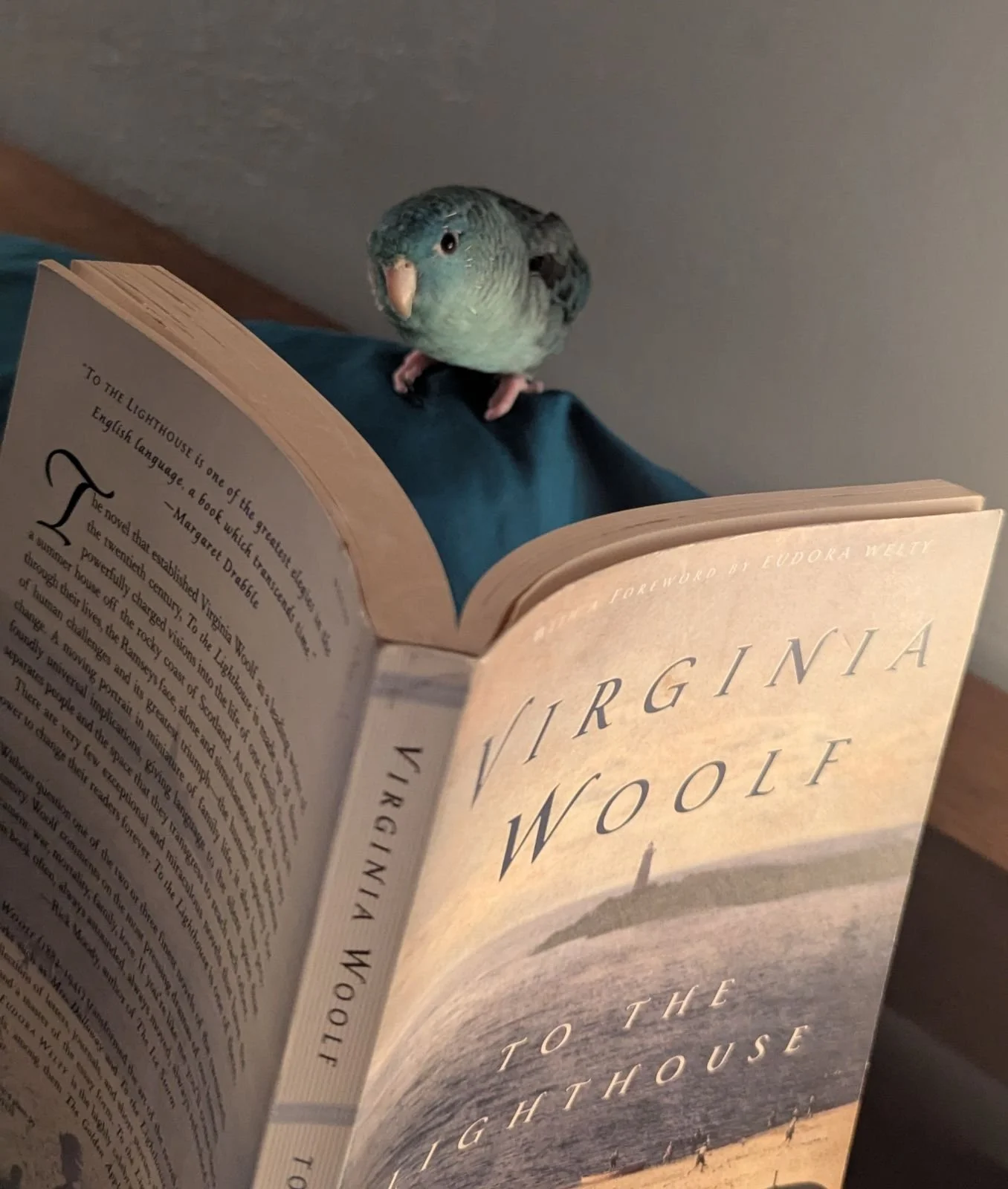
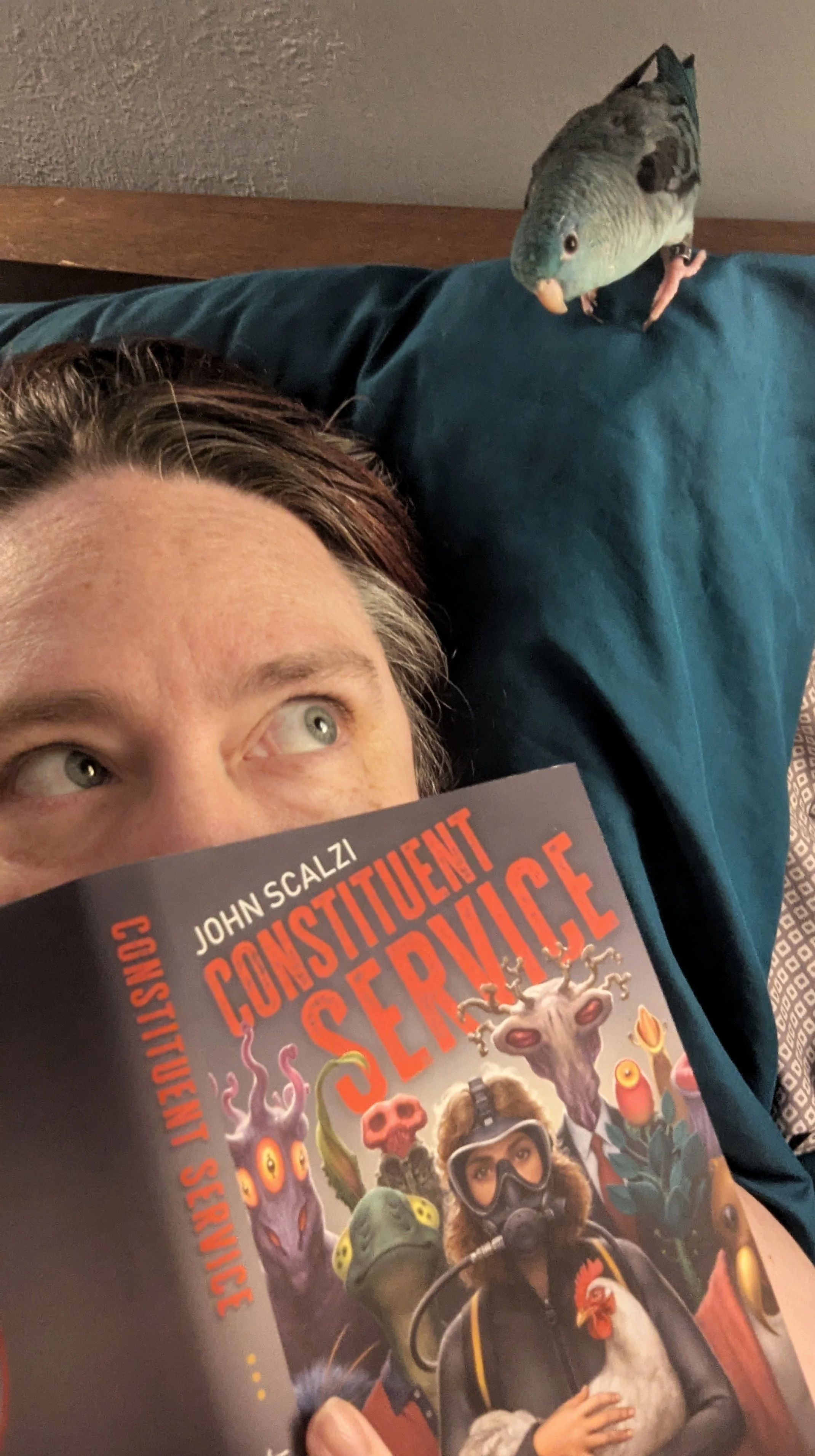
Nominated by Monique, Barry is a lineolated parakeet (aka a Barred or Carolina parakeet) who turns five on Pi Day. Unlike the many budgies I’ve had over the years, she is not a huge fan of flying and prefers eating a specific corner of her cage, playing with her bells, landing on the bed and wandering around, and sitting on my pillow, keeping me company while I read. I’m so grateful to the ToB for introducing me to amazing long- and short-list reads every year, and to favorite authors like Percival Everett and Rebecca Makkai. Barry and I are rooting for The Director this year!
If you’re interested in nominating a pet as a mascot for this year’s Tournament of Books, contact us for more details. (Please note, this is a paid program.)