
The 2026 Championship
presented by

MARCH 31, 2026 • CHAMPIONSHIP
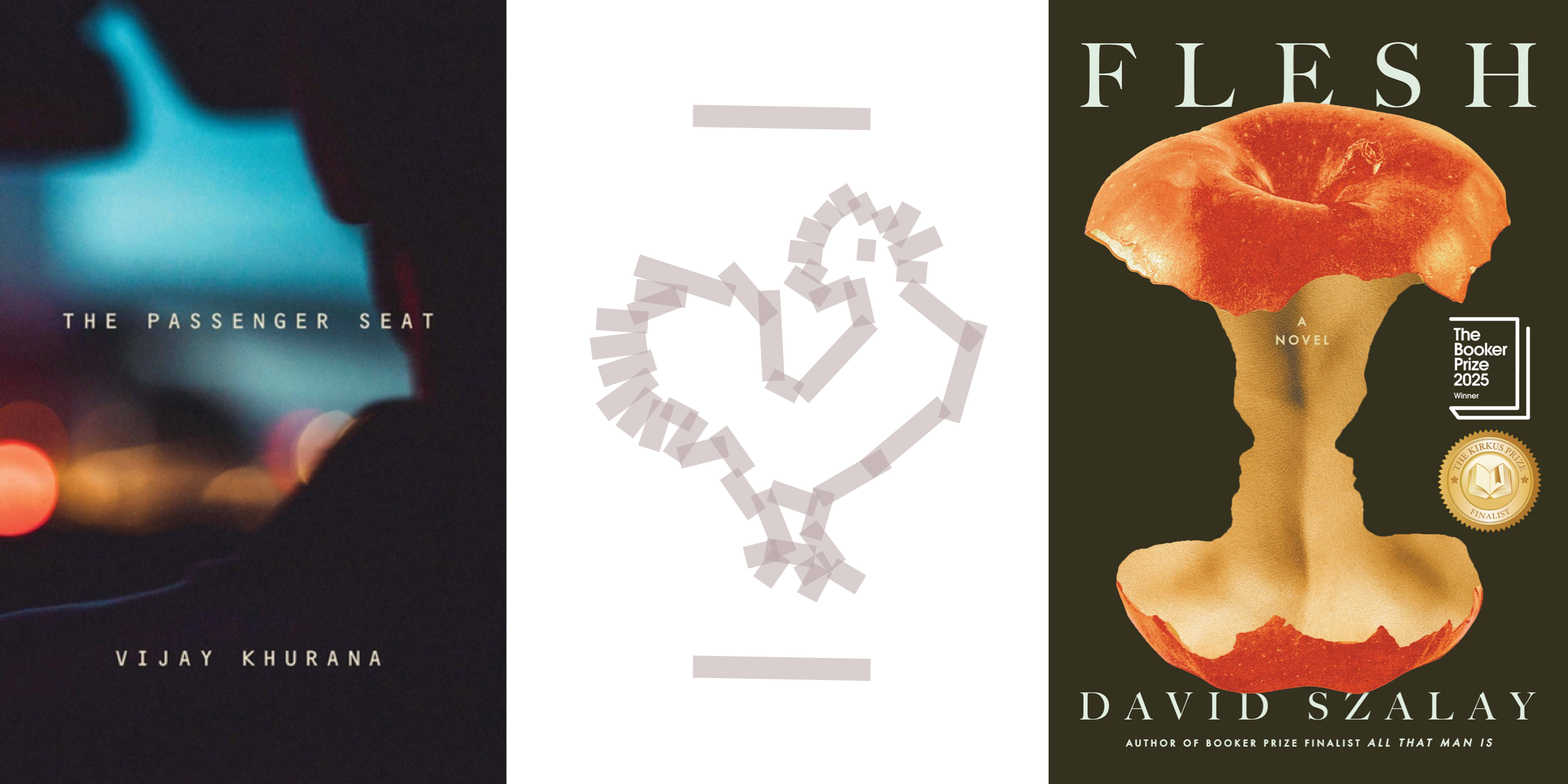
The Passenger Seat
v. Flesh
In the championship match, all of the year’s judges read both finalists, vote for one to win, and briefly tell us how they made their choice. Here are their verdicts.
Natalie Shapero
There’s an immediate asymmetry to this final: Flesh won the Booker Prize and The Passenger Seat is a debut novel I’d never heard of. Going in, I did feel somewhat reluctant to give my vote to a book that didn’t need any additional PR. But while The Passenger Seat is for sure a thoughtful endeavor, Flesh is superb: crisp, understated, brilliantly scaffolded, devastating, and also a total page-turner. Everything that happens in Flesh is entirely determinative of everything that happens next, but the book is also an unusually successful exploration of utter unpredictability. Damn. Flesh it is.
The Passenger Seat 0 ⏤ Flesh 1
Danny Abel
Both Flesh and The Passenger Seat kept my Kindle glowing deep into the night. Spare yet propulsive, each maps the dread of men not on speaking terms with their own feelings—and the consequences of acting on instinct alone. In The Passenger Seat, that instinct gets a lethal boost from the dark internet prophets whispering in the margins. Both books are devastating. In some ways, Flesh is the more formally surprising. But Flesh already has its Booker. Today I cast my vote for the literary world’s second-most important prize for the debut. The Passenger Seat advances.
The Passenger Seat 1 ⏤ Flesh 1
Lilliam Rivera
It’s wild how these two novels are both giving “What’s wrong with these boys to men?” vibes. The Passenger Seat is too real in its depiction of a dysfunctional young male friendship with teens who most likely idolize the Joe Rogans and Andrew Tates of the world. On the other hand, Flesh’s rise and fall of a quiet Hungarian who ends up in London is quite the seductive trip. There’s a voyeuristic quality to Szalay’s character who only lives in action and is devoid of introspection. Plus, I liked the rich people drama. Flesh is a yes for me.
The Passenger Seat 1 ⏤ Flesh 2
Katya Apekina
Both Flesh and The Passenger Seat take on masculinity—what it requires from people and what it robs them of. Both books were a tense read. The Passenger Seat is more heavy-handed in its messaging—it’s in the point of view of two teenage boys who kill people, and a man peripherally related to them, who didn’t kill people but might as well have, because they were all in the same soup and thus morally implicated. Flesh was more compelling to me. The prose had a precision and crystalline clarity. The white space around the words was the abyss.
The Passenger Seat 1 ⏤ Flesh 3
Nicholas Bredie
One of the Passenger Seat’s epigraphs is “When two men say hello on the street, one of them loses.” Okay. One man is sweaty, removed, smokes too much. The other is fidgety, self-conscious, maybe smells. Both are killers. Both are fish-bicycles, though one comes with sex appeal. Both are borne forward by events they don’t understand, but only one is concerned how it will all appear in the end. We all want the underdog to win, but both books agree, it doesn’t work out that way. Okay?
The Passenger Seat 1 ⏤ Flesh 4
Susannah Breslin
I pick Flesh, but I feel guilty for not picking The Passenger Seat. Let me explain by way of a dating metaphor. First, I went out with Flesh, which was stern, difficult to read, and cold. Then I went out with The Passenger Seat. It was warm, bubbly, and quoted poetry. I wanted to run off with The Passenger Seat, but I worried I would wake up one day and it would be gone. So I picked Flesh, less fun, sure, but more reliable.
The Passenger Seat 1 ⏤ Flesh 5
Geoff Manaugh
I’m in the slightly strange situation of knowing I am much more likely to recommend Flesh by David Szalay to my friends and colleagues—that, of these two novels, Flesh is the one I believe other readers are most likely to enjoy—while simultaneously thinking that The Passenger Seat by Vijay Khurana is a stronger work, more impressively wrought and better written, on almost every front. There was a cinematographic clarity to The Passenger Seat’s narrative that I found continuously astonishing, a novel of significance-through-detail that, for me, managed to elicit equal parts torpor and dread. Flesh’s portrait of an empty man quietly acquiescing to a life other people have chosen for him is devastating, I will admit, but nowhere near as melancholy as I wanted it to be; in the end, Flesh lacked a true emotional punch. It was Houellebecq adapted for TV. Although fewer readers may appreciate its subarctic, at times psychotic, eeriness, I nevertheless choose The Passenger Seat to take home this year’s prize.
The Passenger Seat 2 ⏤ Flesh 5
Tomi Onabanjo
Like István, the protagonist of Flesh, I’ll be annoyingly terse: I choose The Passenger Seat. I could end right there. But, unlike István, I will try to explain how I made a decision.
My initial judgment hinged on legibility. I did not “like” reading about Adam and Teddy. Yet, in its utter fidelity to masculinity’s social scripts and written with the intimate interiority of the best fiction, The Passenger Seat made me recognize them. And in recognizing them, I recognized some of myself. None of us are Pontius Pilate; no man’s hands are clean. This point transfixes and transcends.
Following István, on the other hand, felt like jimmying a gummied door. With his oblique “Okays” and stolid “I don’t knows,” Flesh doesn’t let us discern—or discern deeply—why István does what he does or is who he is. Admittedly, this glazed opacity might be the point. But, a novel where most insights remain purposefully skin deep? Now, that’s something I don’t like reading.
The Passenger Seat 3 ⏤ Flesh 5
Alex Brown
Judge Brown read both books and elected to abstain from voting for either title.
The Passenger Seat 3 ⏤ Flesh 5
FROM OUR SPONSOR

Deesha Philyaw
I was drawn in by The Passenger Seat’s lean prose and timely meditation on masculinity and manhood, but its narrative voices possess a self-awareness that the characters themselves don’t seem to possess. Flesh, with its disturbing and heartbreaking first chapter, was a bit uneven in terms of tension after that. Also, there were gaps in István’s (the main character’s) interiority. But I chalked that up to being a feature—an unfortunate result of his past experiences—and not a bug. I didn’t love either book, but Flesh was the one that kept me curious and engaged.
The Passenger Seat 3 ⏤ Flesh 6
Sarah McCarry
Can I pick none of them? To be quite frank, if I am going to read a book that has got a man in it, I prefer him to be doing something that is interesting to me personally, such as murdering his classmate after accidentally dismembering a farmer during a woodland bacchanal, or being gay on a whaling ship with a wacky captain. I found both of these books excruciating, but I find masculinity excruciating, and am clearly unqualified to comment upon its exegeses. If I want to know what’s wrong with white men, I’ll read the news, thanks! Flesh had significantly less dialogue that read as though it had been copy-pasted from Reddit forums whose existence I prefer not to think about, so Flesh for the advancement it is, I guess, despite the fact that the word “okay” appears in this novel a minimum of seventy hundred times per page. Okay! I’m going back to Helen Garner’s diaries now.
The Passenger Seat 3 ⏤ Flesh 7
Leon Hendrix
The Passenger Seat is a casually unsettling novel as current as it is strange and disturbing. Meanwhile, István, the hapless, reactionary and fatally earnest protagonist of Flesh, is a man I’ve seen before—in the gym. In a conference room. In the mirror. István’s uneven attempts to navigate the emotional thicket of tragic and awkward sexual, social, and professional pitfalls of life feels far more relatable and timeless. Seat keeps its secrets while Flesh exposes its heart. The latter reminds us that the boys our society constructs—soldiers, drifters, lovers, failures—are human and deserving of scrutiny and guidance in equal measure. Given a choice between the specter of inscrutable male violence, or eroding the façade of stoic masculinity, I chose Flesh.
The Passenger Seat 3 ⏤ Flesh 8
Sarah Anjum Bari
I was intrigued by how these books use journeys to shape character development. In Flesh, the more capacious course of a life spread out across locations and timelines, and as a result, the strange illusion of slow-moving scenes that quickly propel the plot. Reading Flesh felt like being in a fugue state. In contrast, The Passenger Seat uses the containment of a road trip to reveal how two young men are grappling with their definitions of masculinity, power, knowledge, experience, how those ideas sour and manifest in actual danger for others. The Passenger Seat made me sit up in angst, think through difficult ideas within the space of individual scenes and sentences. I wanted to like Flesh more than I did, but ultimately loved The Passenger Seat more for the complexity (of prose, interiority of characters) that it demonstrates on the page!
The Passenger Seat 4 ⏤ Flesh 8
Sam Macon
What is the deal with men? Are they okay? Reader, I regret to inform you: They are not. But some of them can, indeed, write, and here we have two stellar examples. I advanced Flesh in the opening round and white-knuckle-devoured The Passenger Seat for the final. Honestly, I loved them both.
So, in choosing between two books that examine our modern Problem With No Name, I found myself thinking about urgency. While Flesh is perhaps the “better” book by traditional metrics, The Passenger Seat is an alarm bell. It’s a scream. With its knotty and nuanced depiction of young men and the irrational violence they commit, The Passenger Seat may not be everyone’s cup of tea, but to that, I say respectfully: We are living in a world shaped by problems, named and unnamed, long ignored. You may want to look away (or let someone else drive), but you do so at your peril.
Flesh can have the Booker, but I’m compelled to give the Rooster to the book we can’t afford to look away from.
The Passenger Seat 5 ⏤ Flesh 8
Spencer Williams
There was a lot I admired about Flesh, but I found the sparseness a bit too distancing and cold overall. In contrast, I found The Passenger Seat to be absolutely enthralling. By this I mean I was invested in the never-ceasing dread and disgust I felt while reading. I never knew where Khurana was going to take me, even if I had a sense that it was nowhere good (positive!). I could only get through the bleakness of these novels with the help of various adult beverages and strong water pressure.
The Passenger Seat 6 ⏤ Flesh 8
Cassandra Lane
To live inside the mind of masculinity gone awry is a dangerous thing—even for the length of a novel. Both Flesh and The Passenger Seat center teenage boys/men who find themselves in a world of trouble that is either thrust upon them or is of their own making. Both novels explore the isolation, loneliness, and meaninglessness of young men unmoored from purpose and deep, honest relationships. They bury their trauma, frustrations, and insecurities in substances, sex, and superficial exchanges. And this epidemic of male drift is not relegated to youth; both novels trace the phenomenon across time and age. “They are expert skirters of an issue; soon they have moved on to the problems they read about and have opinions on, matters in which they are powerless and therefore blameless.” This is a line from The Passenger Seat, the novel I am advancing expressly because it delves into the interiority of its characters, creates tension through movement, and poetically brings each setting into focus in contrast to Flesh’s sparse prose, staccato dialogue, and flatter reading experience.
The Passenger Seat 7 ⏤ Flesh 8
Neelanjana Banerjee
Vijay Khurana dedicates an incredible amount of time to detailing the stink of the two teenage boys in The Passenger Seat. It was masterful and disgusting, but being stuck in the backseat of their trip was nauseating. It made me feel the way I did when I was pregnant and sensitive to smell and stuck on public transportation. I had to force myself to finish this book. I do think it was incredibly written (that last section!), but being this close to these young men at this moment in time made me feel an unshakeable dread. I’d rather sail along István’s sad and distant life in Flesh, where the violence and emotion are disassociated, just like I like it.
The Passenger Seat 7 ⏤ Flesh 9
This year’s champion:
Flesh
Match Commentary
with the Tournament of Books Staff
Rosecrans Baldwin: Congratulations to Flesh in a very tight final! The chronology above pretty much reflects the order in which we received the judges’ votes, and we were on the edge of our seats.
Per custom, we reached out to Flesh’s author David Szalay and offered him a live (rescued) rooster for his award. He declined, but he did have this to say:
I’m flattered and honoured to hear that Flesh was the last book standing, no doubt bloodied but hopefully unbowed, at the end of this wonderfully eccentric but also deeply serious tournament. Many thanks—and apologies that I’m not in a position to accept a rooster!
Andrew Womack: In honor of the win, we are making a donation in Flesh’s name to the American Library Association’s Unite Against Book Bans.
Now it’s time for some well-deserved thank yous, starting with our Sustaining Members for making another year of the Tournament possible, as well as to all our match mascots (and their human counterparts), and also to all our judges, match commentators, and everyone who participated in the comments. And a huge, huge thanks to our presenting sponsor Field Notes, whose support and partnership mean the world to us. Go buy their notebooks, you will be glad you started.
Rosecrans: Speaking of Field Notes, it’s time to announce the winners of yesterday’s guess-the-spread contest. The two members of the commentariat to receive a free quarterly subscription are @itsonlyzach and @Orangecatbrain!
Onlyzach and Orangecat, please email talk@themorningnews.org with your info and we’ll get it sorted. Thanks again, Field Notes!
And now I’ll hand the mic to our esteemed commentators.
Kevin Guilfoile: The Tournament of Books, which began more than two decades ago as something of a joke among friends, has evolved into an experiment that explores, among other things, why we read fiction. As these two novels made their way to the finals, I think we discovered why a lot of people don’t read. (Have we ever had a judge in the finals refuse to vote, while another wonders aloud if abstention is a possibility?) These novels, and especially The Passenger Seat, are the opposite of escapism. With the world doing so much sucking, we don’t all want to spend precious reading time being reminded of our powerlessness in the face of the suck. Intentional discomfort is a luxury that many of us, understandably, reserve for better times. But as several judges point out (specifically Judge Macon) we look away at our peril.
Alana Mohamed: Oh, my horrible, terrible, no-good boys made it further in this competition than I would have ever dreamed! Like Judge Onabanjo, “The Passenger Seat made me recognize” and “in recognizing them, I recognized some of myself.” Maybe it is a mark of my own self-involvement that I thought it had less to say about The Troubled Boys than it did about myself, and that I found this empowering rather than disempowering.
That being said, I completely understand why this matchup is contentious or disappointing or why, simply, people are over reading about men.
Meave Gallagher: Hi, I’m experiencing extreme personal burnout, but regarding The Passenger Seat: Teddy and Adam, as I tried to allude to when referencing Elliot Rodger, are much more would-be Terrorgram types—except neither were written as terminally online as I would expect young men their age to be. Neither of them speaks in memes, which is a hallmark of the manosphere red/blackpill pyramid scheme he-man woman-hating demo. (And no one who cares about the self-reliance and living off the land Adam natters on about fucks with those scammy pimps the Tate brothers.)
Also, both these novels could easily be read through a class lens! HELLO? They may be “about” men, but in this essay, I will argue they are about the violence of late-stage capitalism and decades of neoliberal policies imposed on ordinary people, which is—as Alana and I briefly mentioned in an earlier commentary—even starker a contrast in Flesh, which begins at the end of communism in Hungary…
Men aren’t the only ones “in trouble,” and they’ve always been “more dangerous,” more prone to interpersonal and societal violence. Oh! And fascism, they’re definitely about the effects of the rise of fascism in our weak democracies, which have allowed and even encouraged it to flourish in the name of “progress” and “the Cold War.” Seeing Like a State would make a terrific palate-cleanser. 😹😹😹
Kevin: I think it’s certainly correct that these novels could be read through a class lens (or a feminist lens or any other manner of lenses), but I think they (and The Passenger Seat, especially) resonated with so many judges this year because of the direct lines people drew from these characters to the current moment. Anyone who has teenage or young adult boys will read this book and recognize the algorithm young men are being force-fed right now, and you don’t have to have to be on TikTok or Telegram 11 hours a day to be drowning in it.
Alana: I too wonder if we overemphasize gender at the risk of ignoring the rest—as you mention Meave, class, and also the spread of American capitalist hegemony after the fall of the Soviet Union. In that way, Flesh could be understood as an inversion of those Horatio Alger-type “rags-to-riches” stories that continue to be popular in American imagination. And, of course, I won’t stop honking on about race and Khurana’s hints throughout The Passenger Seat that the kind of violence we see throughout the novel is not contained neatly in the “white middle-class man” archetype.
I enjoyed both books more than I thought I would and ultimately I am invigorated by the robust discussion they have inspired!
John Warner: The ends of things are always good moments for reflection, which I'm attempting to do myself, though you also don't want to spend all of one's reflection time on recrimination. I have no great love for the Duke men's basketball team, but I was struck by their first-year (and probably only year) point guard Cayden Boozer saying, “I ruined our team’s season” after a turnover resulted in one of the most improbable comebacks in NCAA tournament history to the delight of UConn’s fans. To some this is the greatest game of all time. To others, an unmitigated disaster. I understand Cayden Boozer’s sentiment, particularly in the immediate aftermath of the game, but I’m certain they had lots of unalloyed great moments this season and you hope that over time those aren’t erased entirely. I can genuinely say that some of the books on this list provided deep and pleasurable reading experiences for me, books which others found lacking, but that lack for others doesn’t change what happened to me as I read them.
Andrew: Sometimes the Rooster smiles kindly upon a title, other times not so much, but for every reader who took part this year, I hope there was a book you take with you. And for this year’s commentariat who voted in the Henhouse—our readers-choice award—that book was Maria Reva’s Endling!
Now that this year’s Tournament is in the books, let’s look ahead to our summer event. We’re still hashing out what it’s going to be this time around, but you can expect we’ll be discussing new fiction from 2026. So if you haven’t already, make sure to subscribe to the Rooster newsletter at the bottom of this page to see the announcement!
Rosecrans: And for one final request, please drop below the names of any new books you’ve been loving this year, or titles you’re excited about picking up! Because, as ever, we are all ears. Thank you again, we’ll see you soon!
The merch table is open
Your purchases help support the Tournament of Books—plus, get 50% off all items when you become a Sustaining Member.





Wear your allegiance to literary bloodsport with pride. Plus, receive a 50% discount on this item and everything in our store when you become a Sustaining Member.
Unisex fit / soft and lightweight / 100% combed and ring-spun cotton (heather colors contain polyester)