
The Passenger Seat v. Endling
presented by

MARCH 19, 2026 • QUARTERFINALS
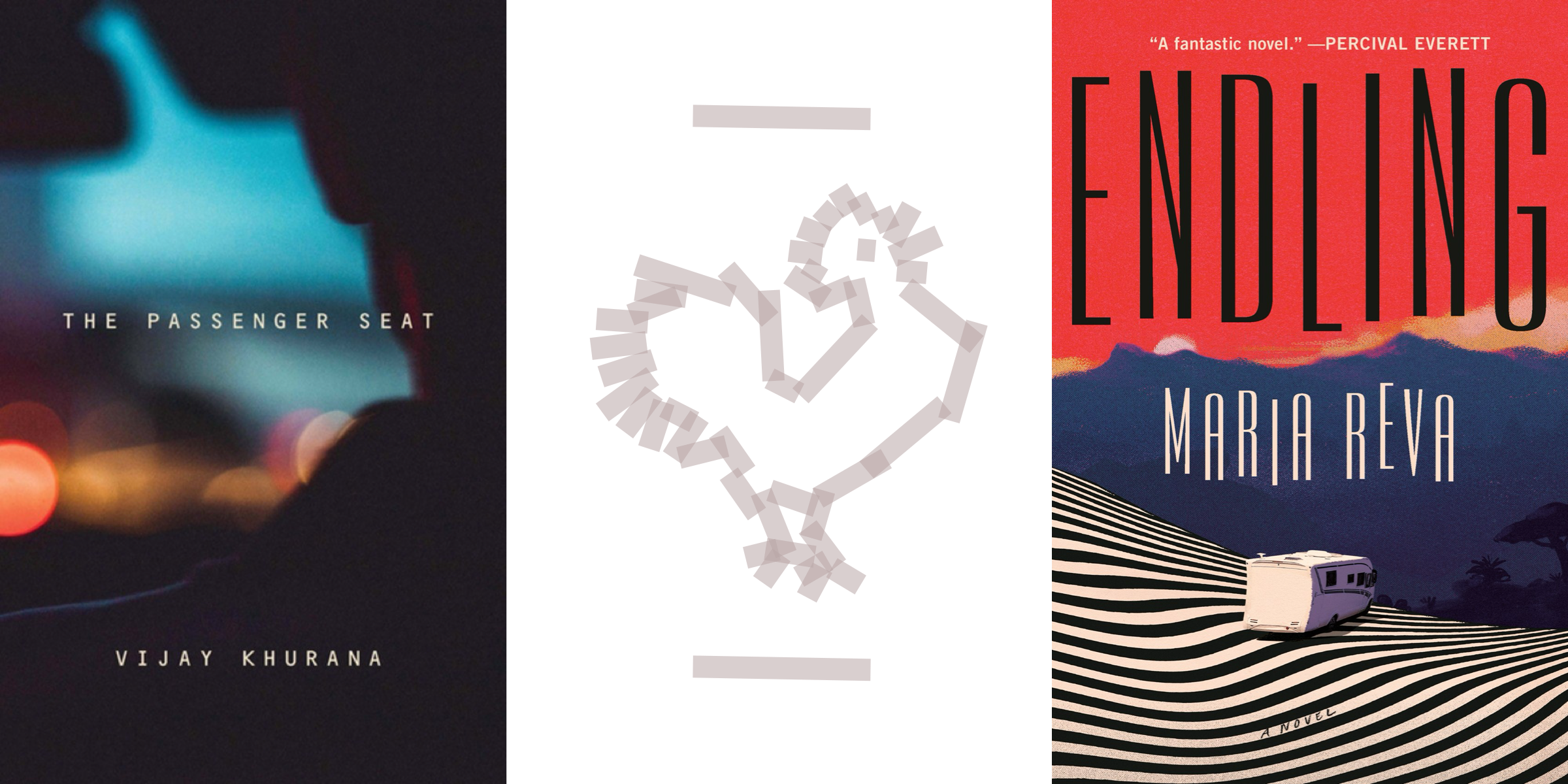
The Passenger Seat
v. Endling
Judged by Geoff Manaugh
Geoff Manaugh is a Los Angeles-based freelance writer, author of the New York Times-bestselling book A Burglar's Guide to the City, and co-author, with Nicola Twilley, of Until Proven Safe: The History and Future of Quarantine, a Time magazine, NPR, Guardian, and Financial Times book of the year. Manaugh regularly writes for venues such as the New York Times Magazine, the Atlantic, MIT Technology Review, the New Yorker, and many others. His short story “Ernest” was adapted by Netflix into a feature film called We Have a Ghost. He is currently working on a new book, about archaeology in an age of electromagnetic sensing. Known connections to this year’s contenders: None. / bldgblog.com
These two novels, both very much of their time, display exceptionally different stylistic approaches. One—about two boys disoriented in the face of incipient manhood—psychotically inches forward through violence and dread to arrive at a state of precarity. The other—convulsing with war, extinction, and reluctant fertility—fragments into metafiction, a hall of mirrors in which the author interviews herself about how to finish writing the book, some scenes are reframed multiple times with different outcomes, and a caper-esque tone verging on slapstick comes to dominate.
The Passenger Seat by Vijay Khurana flows by in what feels like a dream state, a humid summer haze made all the more unsettling by the book’s casual violence. Loosely based on real-life killings by two young Canadian men in the summer of 2019, Khurana’s novel could be described as a speculative reconstruction of that ultimately suicidal crime spree. The novel’s protagonists, Adam and Teddy, despite their aggression, feel eerily passive, both drawn along in an ambience of torpid inevitability. Their decisions, literally murderous, never quite ground them. Instead, these two not-yet-men float together in a homoerotic whirlwind of ferality and violence through the wild landscapes of the north, marking that vast geography with improvisational acts of homicide. Both boys seem stuck in the titular passenger seat, going along with something neither seems to realize should be stopped. Like many young men, Adam and Teddy long to experience something like a hero’s arc—the journey, the quest, the odyssey—but, instead of learning how to heal themselves, they’ve decided to injure others.
Throughout my reading of the novel, I found myself thinking about the micropolitics of representation, or who is allowed to depict whom and under what circumstances. Who can be a hero? Who can we villainize? Speaking perhaps only for myself, there was something slightly uncanny in The Passenger Seat, seeing how seething barbarism, if committed by people who look like me—specifically, white North American males of at least implied European ancestry—can assume such rich symbolic potential in the eyes of others. It is as if the world seeks to learn something of itself, or about the human condition writ large, when people who share my physical characteristics engage in random brutality. Would that change if Khurana’s protagonists had been Black American teenagers or, for that matter, South Asian boys on a killing spree? Whose violence do we elevate with the power of the symbolic?
FROM OUR SPONSOR

The risk here, as I see it, is that if even rootless white males with no professional future like Adam and Teddy can achieve mythic resonance by murdering strangers, this inadvertently maintains the very hierarchy in which such boys obtain agency and cultural power. I couldn’t help but wonder whose violence does not have literary meaning and who, both culturally and politically, we would allow to explore it.
These kinds of extra-literary questions aside, I was often mesmerized by Khurana’s superb eye for details heavy with moral implication, often packing entire worldviews into small observations. “From an early age [Teddy] has been taught that to have something—a toy, a trophy—counts double if your friend has none,” we read. Khurana also maintains impressive control over the book’s staging and cinematography; the scenes of violence, in particular, seem uncannily half-paced or lit by chiaroscuro. In an early encounter that makes clear the book’s nightmarish destination, the boys accost a young couple stranded with their vehicle on the side of the road. Things go badly: “The man says nothing but his mouth drops open. Adam realizes that neither of them is quite looking at him anymore. Their shoulders are angled like they don’t know which way to twist, as though the wind were blowing them backwards. Only now does Adam allow himself to accept his victory, to break the stare and turn to look at Teddy, though he already knows what he will see.” What Adam sees will be the novel’s inaugural act of violence, committed with blasé detachment, dictating all of what’s to come. (Parenthetically, I suspect that readers of The Passenger Seat might also enjoy Peter Heller’s 2019 novel The River, also about two young men in the Canadian north whose journey exposes them to life-changing violence.)
In Endling, Maria Reva’s imagination fizzes like sparkling wine, overflowing in metafictional asides, counterfeit documents, and in-jokes. The novel abruptly comes to an end roughly two-fifths of the way through—complete with an official acknowledgements page and a fictional Note on the Type colophon—before slowly meandering back to the book’s original storyline. Almost insolently confident, Endling’s creative flourishes might suggest a writer in full command of her material. I suspect for many this will be a thrill. I had a different reaction. To me, the self-conscious postmodernism became distracting, even gimmicky, and I was quickly frustrated by how large a gap there was between what Endling promised to be and how the book was ultimately realized.
For starters, the metafiction theorizes itself, explicitly drawing attention to the novelist’s inability to focus on and complete writing her novel. Yurt metaphors are pushed to their breaking point. A fake grant application, seeking funds to write a novel that, like Endling, is set in Ukraine, consumes several pages. The author interrogates herself in Q&A-style subchapters about why she’s writing this book in the first place. Why, she asks—indeed, how could one—write a comedic novel set in a country such as Ukraine today, where friends and family are being slaughtered?
The underlying premise of the book is fantastic. Endling’s plot follows three women as they kidnap a group of foreign men who have come to Ukraine to find brides. Had this been the sole focus of the book, Endling would have felt almost folkloristic, a feminist revenge fantasy, a criminal picaresque, set in a nation facing erasure. Instead, amongst its other postmodern whirls, Endling includes essayistic first-person interludes that step out of the plot and tone entirely to reflect on the Russian invasion—which Reva, to her credit, executes beautifully.
Editorially, however, these moments reinforced my sense that there are two books hidden inside Endling. One is a novel, a mischievous and often quite funny caper about Ukrainian women who have kidnapped foreign suitors in a war zone. The other book hidden inside Endling is a nonfiction reflection on Russia’s invasion of Ukraine. I may be alone in this sentiment, but trying to weave those two books together, with their jarringly different registers, felt like a tonal mistake. The novel’s lurch toward metafiction came across more like authorial panic, a last-ditch attempt to pull two very different manuscripts together in time for publication. (I should add that there is a subplot, involving a loveless snail facing extinction, but it disappears so thoroughly from the book that the snail’s later reappearance as a key driver of the story seems oddly miscalculated.)
What’s more, when the novel’s action reaches the Ukrainian city of Kherson, it seems even stranger that Endling jumped around so much in its first two-thirds. With its characters stranded in Kherson, the book settles—or perhaps stalls—into a 100+-page scene where the protagonists are trapped in the filming of a Russian documentary. All of the cleverness—the fake grant applications, the fictional correspondence with editors and agents, the imaginary interviews about yurts—seem, in retrospect, to have been little more than procrastination, delaying our arrival at a novella-length scene that frankly overstays its welcome.
Given their strengths, I would happily read future books—fiction or nonfiction—by either author, but, for all its darkness, I am advancing The Passenger Seat by Vijay Khurana.
Advancing:
The Passenger Seat
Match Commentary
with Meave Gallagher and Alana Mohamed
Alana Mohamed: Hello, Meave and commentariat! We’re kicking off the quarterfinals with a pair of books I really enjoyed. I was leaning slightly more to Endling but Judge Manaugh hit on a couple of things I agree with. He writes that he was “frustrated by how large a gap there was between what Endling promised to be and how the book was ultimately realized.” I wouldn’t say I was frustrated, but I was disappointed. Yet the metafictional elements felt well done to me—I bought the confidence that Judge Manaugh describes as nearing insolence. I thought, yeah, as a reader I’m down for you to take me wherever, even if it is through “authorial panic.” I cannot fault our judge for feeling slighted that what was promised is not what he got. As someone who handwrings about the ethical implications of my work, I appreciated seeing that anxiety on the page, though.
Meave Gallagher: I am exhausted by deconstructing NIHILISTIC YOUNG MALE VIOLENCE. And I should say, chat, while we were writing this, Alana convinced me that my understanding of The Passenger Seat was so skewed, I ended up reading it, so I will be writing from a place of knowledge!
Facts established: Why do I have to deconstruct this? Fuck it, throw the Teddies and Adam-Peters in reeducation camps and never make me think about them again. There are plenty of young men with real reasons to be mad at the world, mad at specific people, even, and none of them raise a hand against another person. I just learned today one of my little brothers in Gaza—I’m a natural big sister, i.e., very easily needled—who graduated with a BS with high honors in bioengineering, and for some reason (Gaza) can’t win a place at an international doctoral program for young scholars living in mortal peril, finds legitimate inspiration from the pigeon doctor meme. It’s huge with him and all his nerd friends who do differential equations to keep their spirits up.
Endling was new and interesting. I liked it. It was weird and funny and hurt my heart. Its very concept did not make me want to scromit. Please, what is the appeal of reading about the banality of young manhood? You can see these dudes every day IRL streaming on Kick, only with less murders (not counting attempted) (allegedly). No one is streaming about preserving indigenous snails or being a mail-order bride—unless the bride has been murdered. Which, again, makes me ask what is the appeal of an Anders Breivik fan and his shotgun-licensed companion? Bonnie and Clyde at least took responsibility for their actions.
Alana: Thinking about the race question Judge Manaugh brings up, to me it’s clear that Khurana is trying to make a point about the violence of white Western men But I do understand that if we read this as a story about maleness in general, one could see the use of white characters as reinforcing the violent systems that inform real life. And I do understand that if Adam and Teddy were visibly Black or South Asian (there are hints in the book that Adam, despite his consumption of right-wing racist rhetoric, is, in fact, mixed), The Passenger Seat probably would not be received as a work about maleness.
Meave: Ah yes, the couple of tossed-off mentions of Teddy’s wanting to ask about “Indigenous folks” (not for one second do I believe anyone in gen alpha would use the word “folks” in that context) and his mother attributing something to “that Indian blood,” though it was unclear to me if she meant “from the subcontinent” or “indigenous to Turtle Island.” What I understood from the judgment, the thing that separated the lads from the world was more class than race. I’ll also note that a talking point among the terminally online is that the Groypers are more diverse than the Republican party.
Alana: Hmm, those mentions of race served a different purpose than the moment I’m thinking about, where Teddy says that Adam has a grandparent from a country he doesn’t know anything about. Am I misremembering? It made me think about how people of color get absorbed into these structures—ICE, Groypers, etc—because they understand themselves as primarily American. I relate. My parents didn’t really want me to know anything about Guyana growing up, so I was very depoliticized. I remember, in a post-9/11 world, becoming a militant atheist because smart-seeming people online presented it as the rational response to those violence-loving, freedom-hating terrorists. I could not recognize this detached pose as its own violence, reducing years of American interventionism in West and Central Asia to ahistorical, depoliticized, racist chauvinism meant to repeat the cycle. It stuck with me throughout the book, so I was surprised to see our judge’s thoughts on race and treatment of Adam as white. (To your earlier examples, I never really bought that Teddy had Native ancestry, I think that’s there to show that he is better versed in appearing progressive, which I find to be a classed thing. He’s not any better than Adam but he constantly paints himself to be because his class positions him a certain way.) And to his our judge’s point—the violence of Arab men or of Black men are also in a way elevated to the symbolic and serve as literary tropes, especially (though not exclusively) for white people, so it did make me think.
Meave: Alana! You and my husband (who you know thinks you are so cool and so smart) have so much to talk about re: assimilation, the effects of being/being perceived as Muslim and/or Arab post-9/11, problematic militant atheism…! Oh, I will be encouraging this conversation.
At the risk of returning to the same well, I feel compelled to refer us to Eco’s “Ur-Fascism” (NYRB, 1995) and highlight his features of Eternal Fascism nos. five through 10: fear of difference; appeal to xenophobia; seeing one’s enemies as “at the same time too strong and too weak;” “life is lived for struggle;” and “contempt for the weak.” Are Adam and Teddy not simply two types of baby fascists?
Alana: I think the novel would agree that they are baby fascists! And, through the perspective of the only “good man” Teddy lnows, that indeed that most men in our society are fascist, or in danger of becoming so. Does that mean their lives are completely irrelevant to ours, to the extent that we must shun reading about them? If you say yes, I see why! But I guess I’ve just admitted to being a baby fascist at one point in my life, so I read Khurana as putting forth a compelling work for thinking through how we are connected to and enable their violence, how we tolerate it at lesser degrees, and how we compartmentalize it to avoid implicating ourselves.
Meave: I was not entirely kidding about the reeducation camps. The joke was the camps part.
We’ll take our cheery leave now, as The Unveiling and its zombie penguins go marching into The Wilderness of Black women’s lifelong friendships. Good luck to Judge Deesha Philyaw—we’re sure John and Kevin will keep you safe!
Kevin Guilfoile: And speaking of zombies, I’m popping in to update our Zombie results. Endling does in fact have enough votes to move it up into the current Zombie standings. If the Zombie Round were held today, The Burning Heart of the World and Endling would be our Frankensteined Bookbindings.
The merch table is open
Your purchases help support the Tournament of Books—plus, get 50% off all items when you become a Sustaining Member.
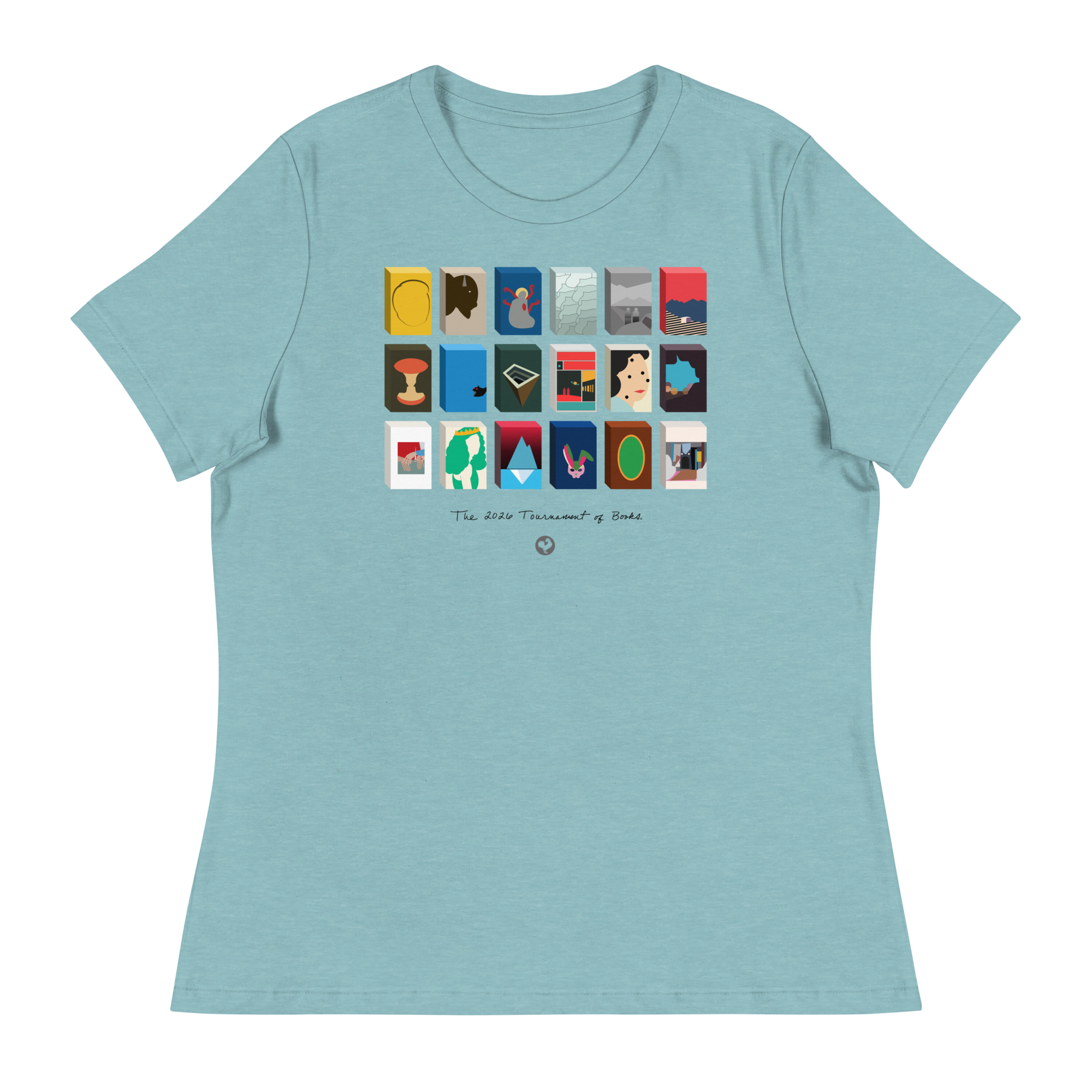
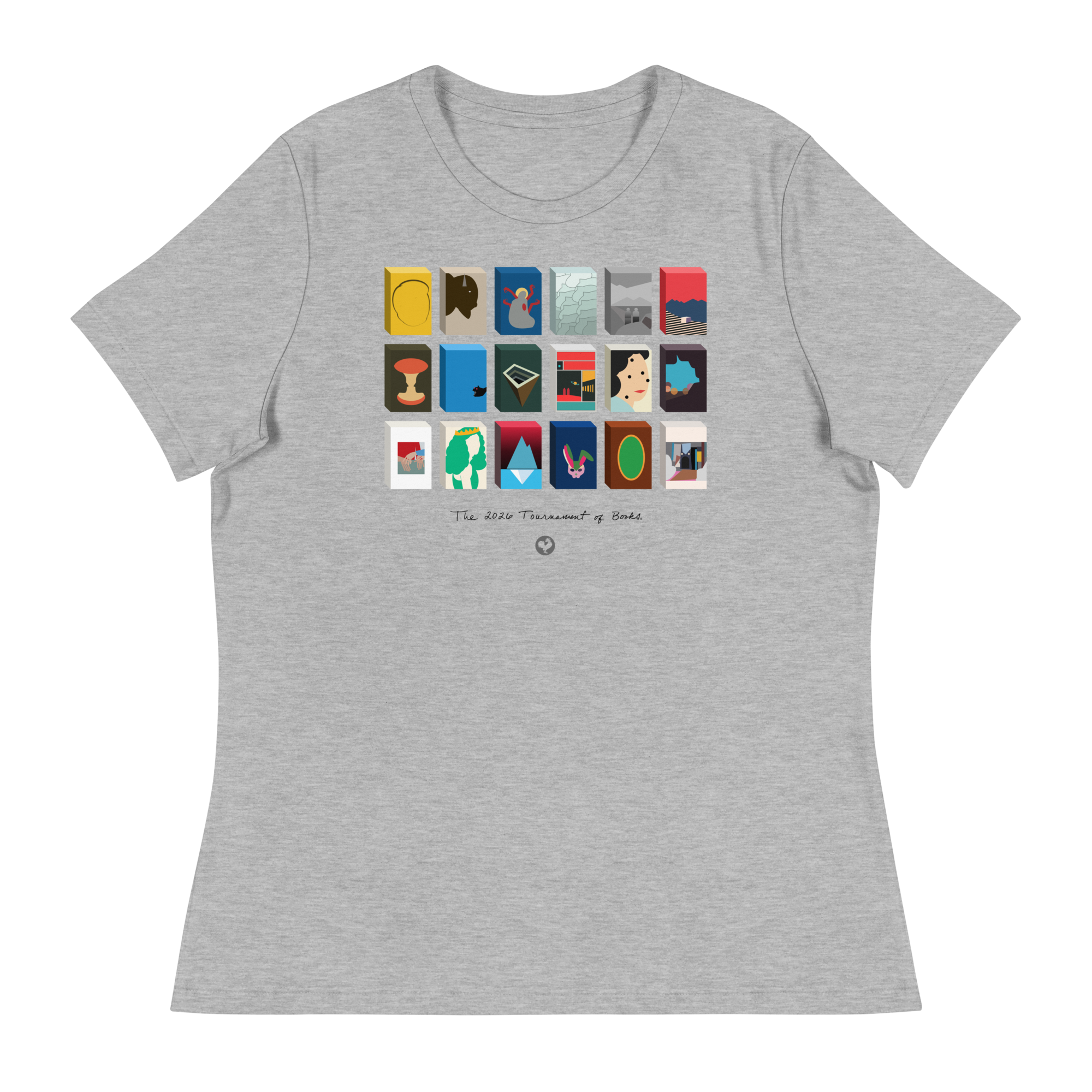
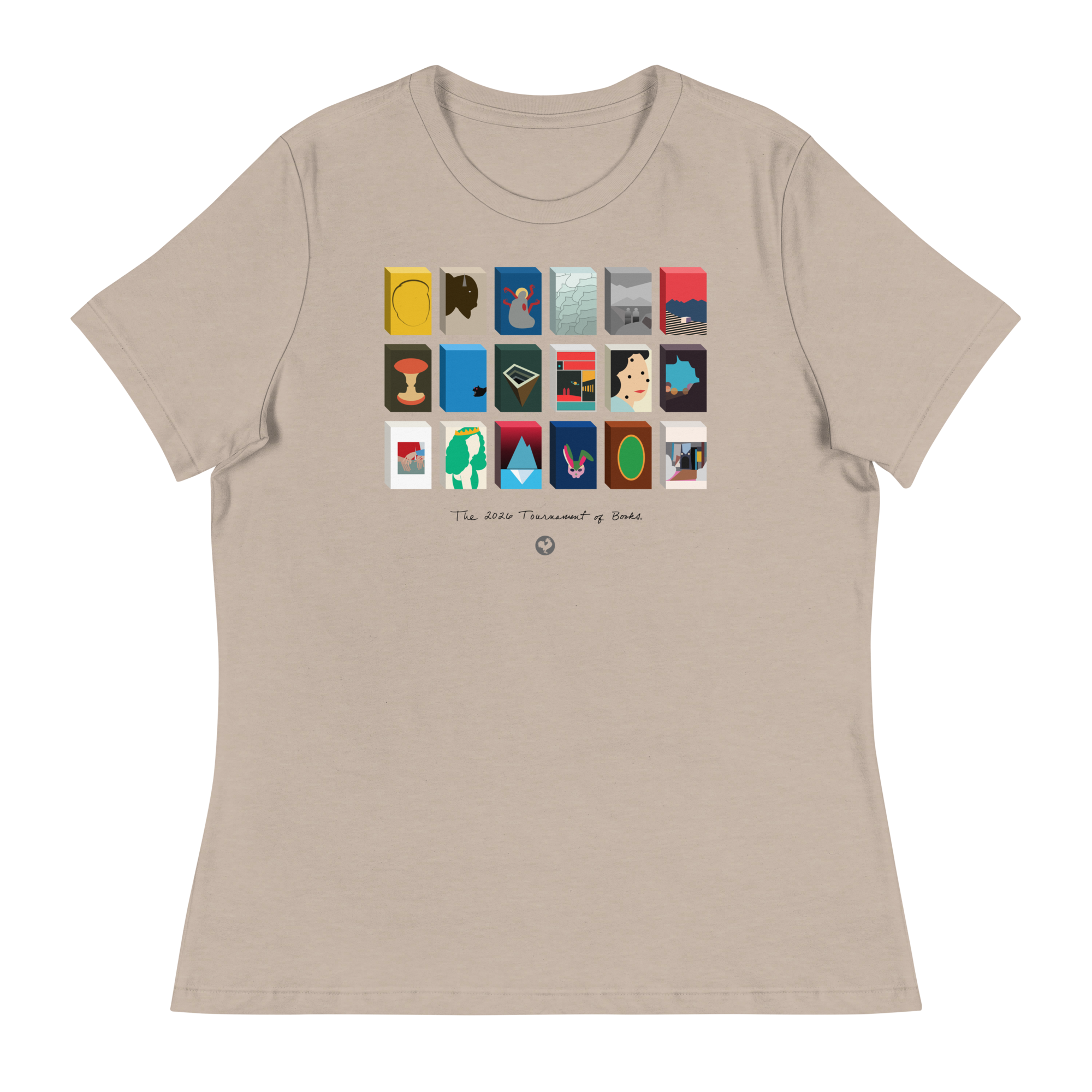
Wear your allegiance to literary bloodsport with pride. Plus, receive a 50% discount on this item and everything in our store when you become a Sustaining Member.
Women’s relaxed fit / midweight fabric / 100% combed and ring-spun cotton (athletic heather is 90% cotton, 10% polyester; other heather colors are 52% cotton, 48% polyester)