Endling v. The Buffalo Hunter Hunter
presented by

MARCH 10, 2026 • OPENING ROUND
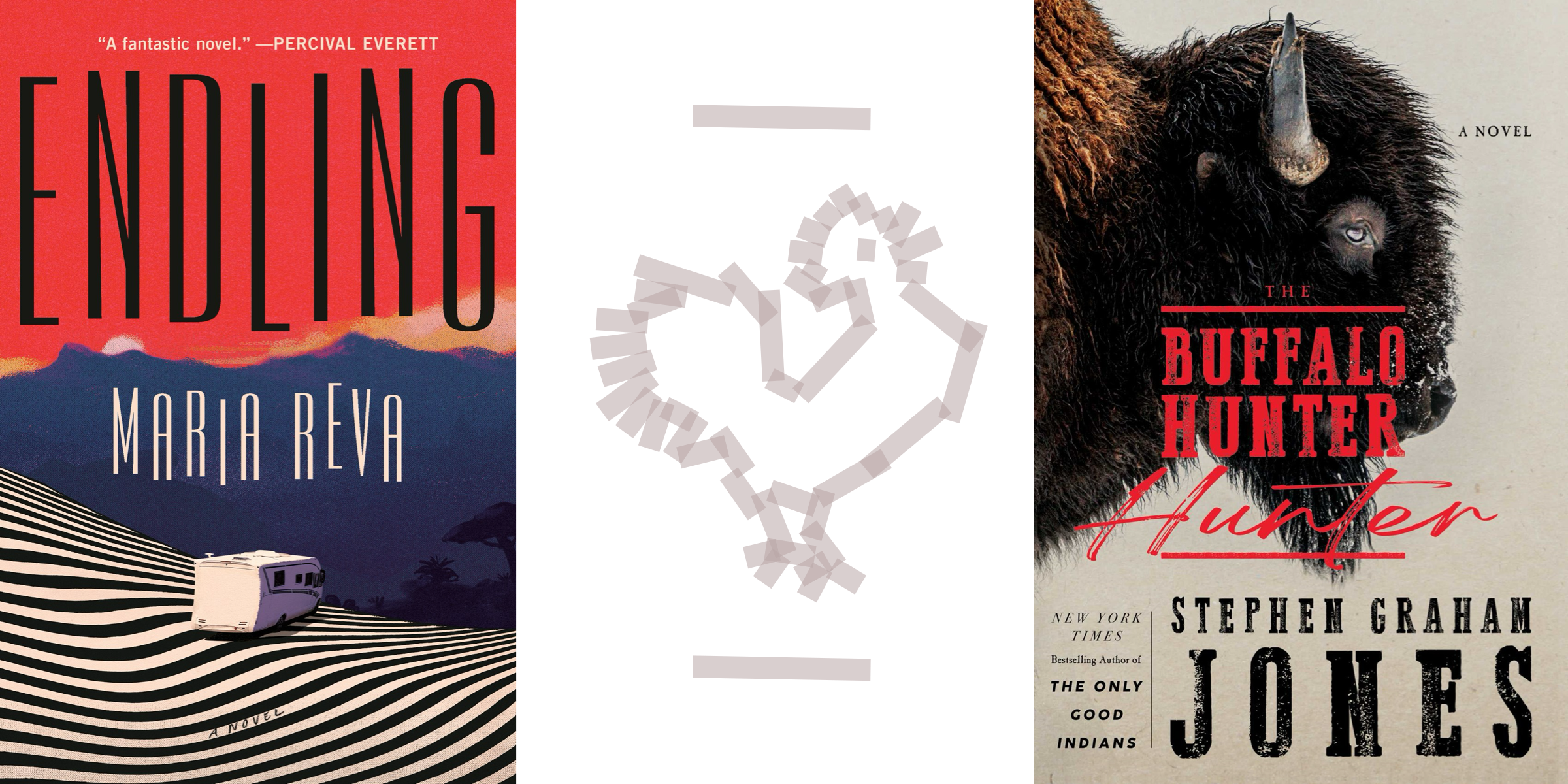
Endling
v. The Buffalo Hunter Hunter
Judged by Nicholas Bredie
Nicholas Bredie is the author of the novel Not Constantinople (Dzanc) and with Joanna Howard the translator of Frederic Boyer's Vaches, published as Cows (Noemi Press). His work has been featured in the Kenyon Review, Ploughshares, Guernica, the Believer, and Public Books, among other publications. He is an Assistant Professor of English and Creative Writing at Utah Valley University. Known connections to this year’s contenders: None.
My creative writing students for the most part don’t like pain and don’t like revision. I can’t really blame them. It is 2026. I find myself buoyed by their space operas and Elvin romances with their unexplored possibilities. The spunky heroine will overcome the baddie who dispatched her family, her golden retriever best friend (either gender or none, one of the few bright spots of our era) sliding elegantly out of the friend zone at the final sunset. It’s 2026 and I don’t think they’ve ever had the privilege of asking, “Which is worse, the present or the past?” I, self-identified millennial literary author, of course ask myself variations of this question all the time. I guess I love pain. I also love revision, and not just in the endlessly mutable variations of sentence and linguistic tone, but in the author-like-god “what-if” power to reimagine a story. I blame Sliding Doors (1998). This has made the task of choosing between Maria Reva’s Endling and Steven Graham Jones’s The Buffalo Hunter Hunter, two books that wield the authorial what-if with undeniable power in the face of historical and present pain, a real pain challenge.
Respecting convention, let’s begin with historical pain. The Buffalo Hunter Hunter takes place in Montana in 1914, though it’s presented as a found text, a journal unearthed by a professor struggling to achieve tenure. (If you believe Ian McEwan, publish or perish will outlive much of civilization, but I digress.) The journal, kept by the village priest, documents his strange encounter with a member of the Pikuni people, known to whites as the Blackfeet Nation. This man, who has many names but primarily goes by “Good Stab” desires confession and absolution, which isn’t typically a service offered by the Lutherans, but the priest is willing to oblige. What follows is an Interview With the Vampire, told in the shadow of the 1870 Marias River Massacre, where 217 Pikuni, mostly women, children and the elderly, suffering from smallpox, were gunned down in the freezing pre-dawn by US soldiers. This alongside the slaughter of the plains buffalo: Beginning in the same year with the expansion of the Union Pacific railroad, a million buffalo were killed from 1877 to 1885, when they were declared functionally extinct. Good Stab, finding himself unusually long-lived, resistant to harm and literally bloodthirsty after an encounter with a “cat man,” does what anyone would do in the face of this destruction.
FROM OUR SPONSOR

The destruction in Maria Reva’s Endling is farther from home, but closer in time. Endling opens on the eve of Russia’s invasion of Ukraine. The characters, ignorant of the war on the horizon, are coping with the slow violence of life in 2022. Yeva, a malacologist deprived of any sort of state or university funding (the more likely future, sorry Ian), drives around the country seeking out snails on the edge of extinction. Many of these are “endlings,” the last documented member of their species, who Yeva attempts to preserve in her mobile lab/camper van. She funds her research working as a mail-in bride candidate through an agency called Romeo Meets Yulia. At the same agency, entertaining so-called bachelors who travel to Ukraine to leverage their economic might in the thinly disguised sex trade, Yeva meets Nastia and her sister Solomiya. Nastia plans to kidnap some of these so-called bachelors as a form of protest in the hopes of exposing the indignities of the bride industry. She convinces Yeva to use the mobile lab to abscond with the captives, the plan falls into place, and they drive into the Kiev night right into the teeth of the Russian invasion. I don’t think it’s a spoiler to say that on page 104, the women pull over. Nastia says, “Just fireworks. Right?” Yeva grabs her hand and the book ends.
So much for pain. What about revision? The Buffalo Hunter Hunter takes perhaps the more direct, more satisfying approach to revising the pain of the past. Revenge—as American as apple pie, Moby-Dick, and James Brown—is what Good Stab delivers cold. First to the buffalo hunters, then in the book’s climax to one of the perpetrators of the Marias River Massacre. In this particularly grisly moment, as both the perpetrator and Good Stab scream, the narrator says, “This, I believe, is the story of America, told in a forgotten church in the hinterlands, with a choir of the dead mutely witnessing.” Amen. Good Stab’s narration also powerfully revises the western landscape, recoding it to a Pikuni understanding of the high plains and rocky foothills, their flora and fauna, the ecosystem and way of life that had been systematically destroyed by white settlers. It’s a tour de force.
Endling, you may have guessed, does not end on page 104, though the author, through various paratexts including correspondence with her editor, a colophon, and an acknowledgements page, argues hard that it should. She imagines the high-rise where her grandfather lives in the besieged city of Kherson. What are the chances it will be struck by a bomb? What can she, living abroad, do to save him? What is a novel in the face of obliteration? Forces, somewhat comically, somewhat doggedly, compel the author to continue, and when she does she performs a full revision, laughing in the face of death. I won’t spoil how she turns things around, but it involves a literal Potemkin village. One snail not only survives but lives to continue the species. At the novel’s conclusion, the author writes, “My awareness of the ridiculousness of the fantasies, of my moral inability to make them come true, did nothing to stop the fantasies.”
Adorno (you saw that coming) wrote in his essay “Commitment,” “Even in the most sublimated work of art there is a hidden ‘it should be otherwise.’” There is no reason to make art simply to present pain, or pleasure for that matter. My students know this instinctually, it’s in their love of pointed ears and faster than light travel. In representing, art offers us the opportunity to revise. Both these authors use their skill to reimagine their subjects, to say in the face of pain, it should be otherwise. Reva is just that much more daring in her revision. When she goes for it, she really goes for it. And she saves the snail.
Advancing:
Endling
Match Commentary
with Kevin Guilfoile and John Warner
Kevin Guilfoile: Unlike Judge Bredie (and you for many stretches of your varied writing career) I do not have any students. But I have run writing workshops and worked with high school students on various writing projects and college essays (so many college essays), and based on that limited experience what Judge Bredie says rings true to me. People don’t like revising. Which is crazy. Rewriting is the best part of writing, maybe the only enjoyable part of writing. When you write a first draft, you are only making a story longer. When you rewrite you are making a story better, and that is where all the satisfaction is. Writing is digging a hole. Rewriting is planting a garden.
John Warner: And revision is not only rewriting, it is literally re-vision/again-seeing, a chance to understand what has been created, and now being recreated in ways that aren’t possible in the initial unfurling. Students want something to be done, and so revision seems like a pain in the ass compared to that desire, but as Judge Bredie so interestingly observes in these novels, nothing is ever done, done.
I sometimes think people suspect us of producing these pairings with the idea of the resonances Judge Bredie teases out in mind, but I hope everyone appreciates the reality that we really are just throwing these things at the wall. It’s the intersection of books and adjudicator that makes them stick.
Kevin: Truth. I love reading judgments like Judge Bredie’s that make associations between the books that I hadn’t seen. The pretense of the ToB is that we read books in pairs and try to figure out which one is better, but that’s not really it. In fact, as we have said many times before, that’s just silly. The real reason we do it is for the kinds of epiphanies about reading and writing that Judge Bredie just gave us.
I much enjoyed both of these novels, although I do have some ambivalence about the meta sections of Endling. I loved Yeva and Nastia and was digging the kidnapping plot—it was wonderfully absurd. The reader knows exactly what’s about to happen and you know it’s going to be great, and then Reva abruptly ends the story and introduces herself as the author and explains her ambivalence about setting this story in a place where there is so much ongoing suffering, and I get that. I empathize. She’s not wrong, I guess. But I think I actually said out loud, “God. Dammit.”
John: Ye olde expectations, thwarted!
Kevin: Yes! And on the one hand I appreciate that. Novels can be all kinds of things and they can be written all kinds of ways, and I love encountering the unexpected. For me as a reader, though, the best novels are often magic tricks in which the author makes themself disappear. And Reva had done it for me. Then she turned the box around and showed me the secret compartment in which she was hiding and walked across the stage and began describing the child laborers who had built the box, and so maybe she shouldn’t even be doing this trick. Again, it’s not wrong to think about that stuff, we should definitely do that, but I was really loving the magic act until then.
Of course she does finish the novel. And it’s terrific. But it’s not the last time she inserts herself, and the author’s ambivalence became my ambivalence, and I couldn’t make her disappear again into the box. That was no doubt Reva’s intent. Like the bachelors locked inside Yeva’s mobile lab as war breaks out all around them, my weekend of pleasure-seeking had been interrupted by reality. It’s a clever narrative trick in and of itself. It is possible, I guess, to make a novel better, but also somehow less enjoyable.
God. Dammit.
John: I am, as a rule, a fan of the meta, but I suppose in this case it depends on how much of a “trick” you think Reva is trying to pull, or what the point of the trick is. Penn & Teller made a career of saying magic is bullshit, but still making the magic enjoyable. Reva is not saying that the novel is bullshit, but there is a sense that for this material, at this time, it may not be sufficient in its expected form.
I’m afraid, probably through no fault of its own, that The Buffalo Hunter Hunter was a DNF for me. In this case, I got antsy waiting for the novel to reveal what I thought was its true nature and tuned out before I got there.
Kevin: It’s a slow build and I can see how some readers might grow impatient with it. The Buffalo Hunter Hunter is a horror novel that cleverly borrows its architecture, as Judge Bredie points out, from another famous horror novel. It has all the elements of classic horror—tension, gore, the supernatural—but for probably the first two-thirds it’s not especially scary. Good Stab’s victims are mostly introduced right before they are murdered, and many of them are deserving of their fate. For a good chunk of the book you never feel like the characters you’ve invested in are in any real jeopardy, and for much (and probably all) of the journey you are on the side of the vampire. (“What I am is the Indian who can't die,” Good Stab says. “I'm the worst dream America ever had.”) Jones eventually introduces the real villain of the story, who is a frightening creation, and we get some fine chills when the contemporary framing device comes back around. It does take some time to get there, but I liked the journey.
It’s a pleasure to see someone with Jones’s writing chops working with such commitment to genre fiction. This is horror in the service of understanding our history and our culture and ourselves, which is much of what we can ask of either literature or horror.
The Buffalo Hunter Hunter also has some of the most entertaining acknowledgments of any novel I’ve ever read. And they came at the end of the novel, not the middle, which the magic fan in me appreciated.
Today’s mascot

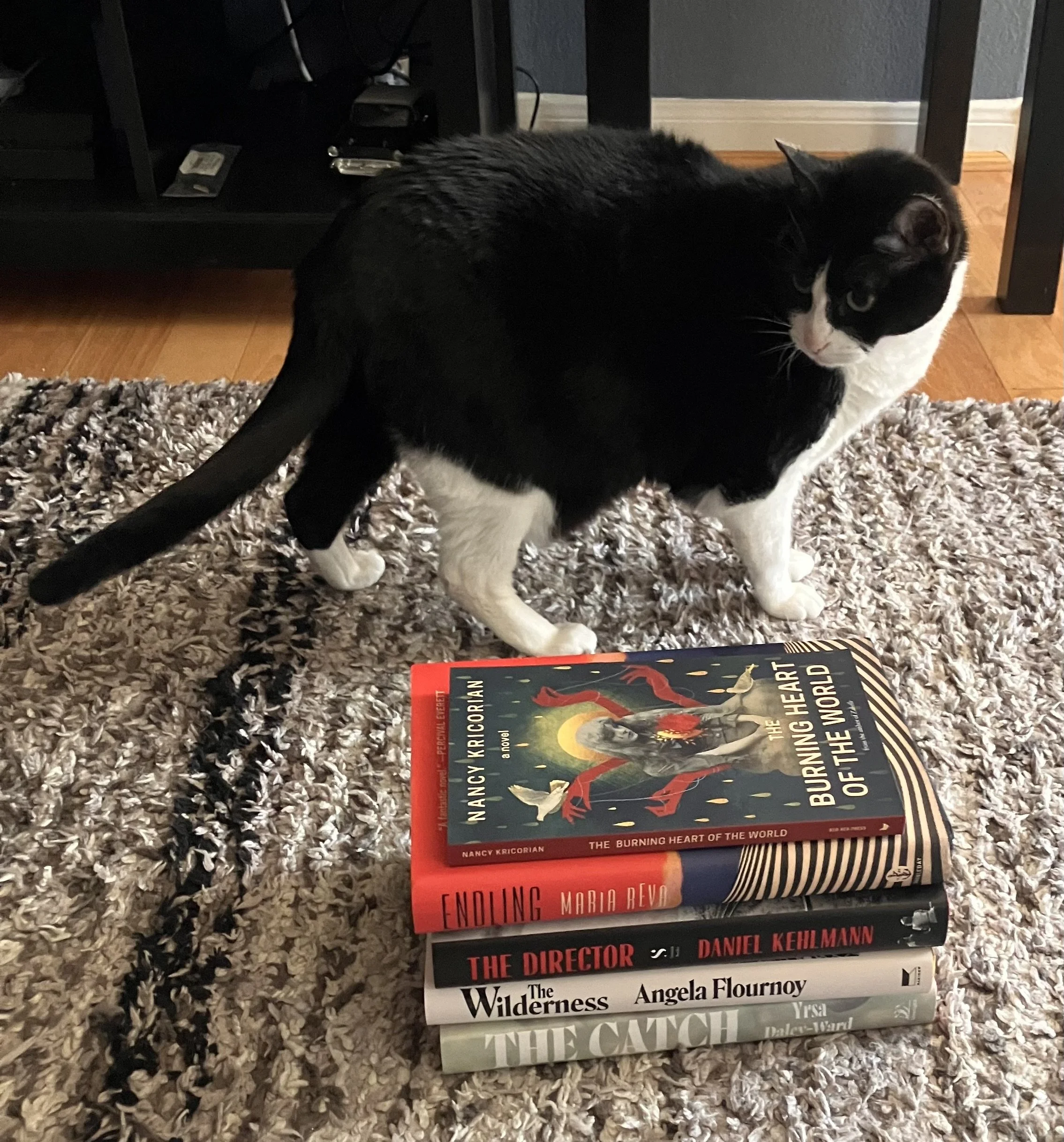

Nominated by Lauren, this is Apollonia, aka the Treat Time Teller, the Crinkle Fish Wrestler, and the String Cheese Stealer.
She is proud of her human’s new website and loves barging in on the virtual writing workshops and consultations in her office. Zoom often shows her best angles.
Appy is rooting for Endling, The Director, and The Wilderness, with a few others also getting her nod of approval this year (including the others in these photos that she was less-than-enthusiastic to have taken of her). But ultimately, she hopes that someday a book about a chunky tuxedo cat will have a chance of winning. She is plotting to write her own novel with her fur-toes crossed for it making the shortlist. Her response to the offer of a live rooster would be, “Heck yes! Bring it to me.” 😸
If you’re interested in nominating a pet as a mascot for this year’s Tournament of Books, contact us for more details. (Please note, this is a paid program.)