
The Wilderness v. The Unveiling
presented by

MARCH 20, 2026 • QUARTERFINALS
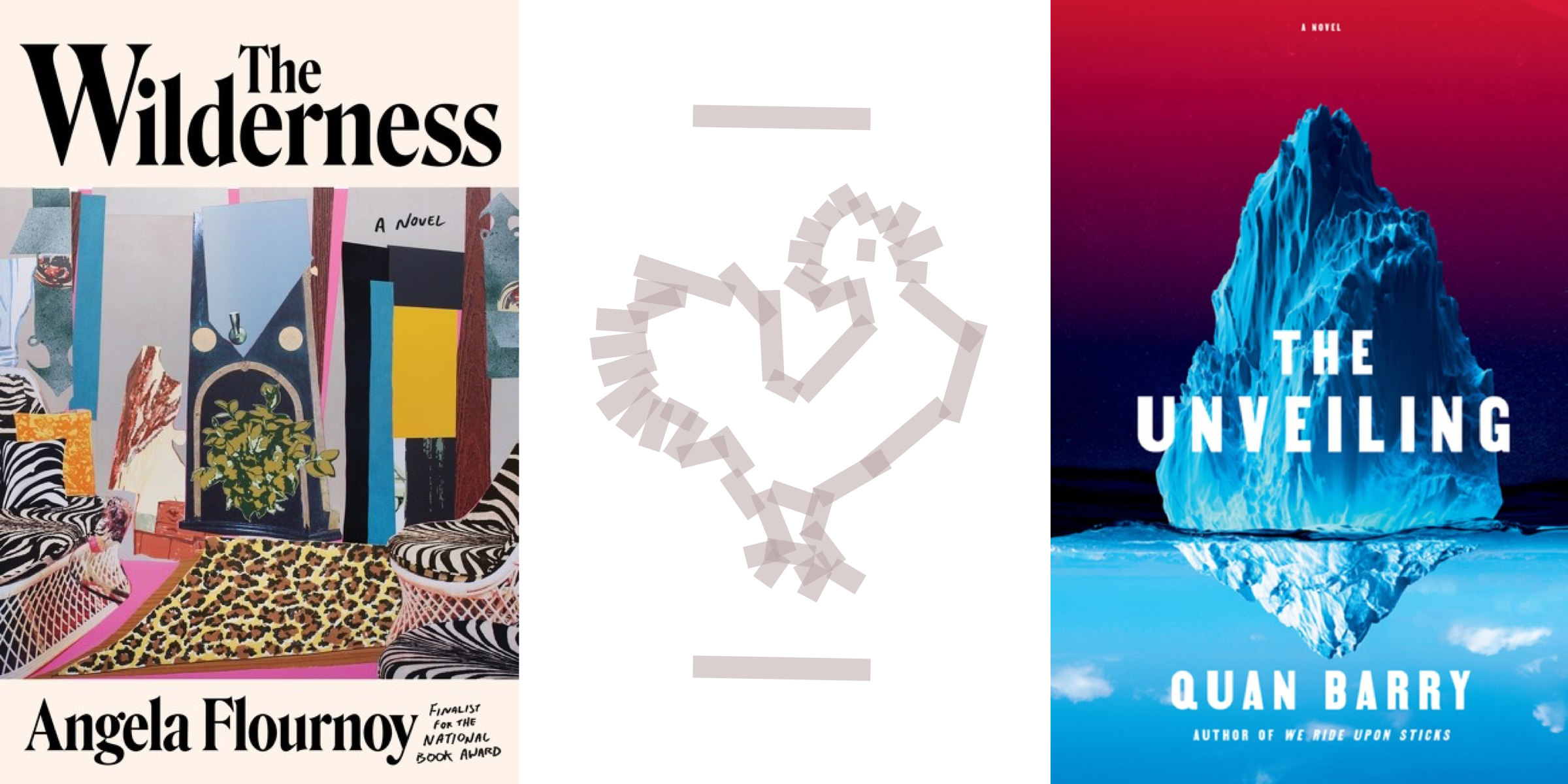
The Wilderness
v. The Unveiling
Judged by Deesha Philyaw
Deesha Philyaw’s debut short story collection, The Secret Lives of Church Ladies, won the 2021 PEN/Faulkner Award for Fiction, the 2020/2021 Story Prize, and the 2020 Los Angeles Times Book Prize: The Art Seidenbaum Award for First Fiction, and was a finalist for the 2020 National Book Award for Fiction. Deesha’s debut novel, The True Confessions of First Lady Freeman, is forthcoming from Mariner Books, an imprint of HarperCollins, in September 2026. Known connections to this year’s contenders: “Angela Flournoy and I have the same editor at Mariner Books, and we both attended the Kimbilio Fiction Fellowship retreat in summer 2017, me as a student, Angela among the faculty, though not the facilitator of my particular workshop.” / deeshaphilyaw.com
The Unveiling is actually not the first satirical novel I’ve read about a Black person in Antarctica. As soon as I read the premise, a voice in my head replayed, “[N-words] on ice!”—a line from an enthused Black character in Pym, Mat Johnson’s hilarious and irreverent 2011 satirical fantasy novel, featuring an all-Black crew on an expedition to Antarctica. The Unveiling, a literary satirical horror novel, features a lone Black woman, Striker, on a luxury cruise to the “ass of the world” to scout locations for a biopic about British explorer Ernest Shackleton.
Striker’s fellow cruise passengers are straight out of central casting for present-day wealthy types. There’s the couple Striker nicknames “Bobbi Sue” and “Billy Bob,” their pre-teen son Mikey, and Anders, their nonbinary teen who uses they/them pronouns and talks about climate change and the evils of capitalism; Taylor, the young, helium-voiced “Tech Titan” from San Francisco who puts her faith in algorithms, but not her useless husband, Kevin; the older couple, “the Baron” and his wife “la Grande Dame” (who has silver helmet hair, natch); and seven-year-old Lucy, a possibly autistic Eastern European adoptee and her three dads, Frank, Hector, and Abbott, who are variously referred to as “one of Lucy’s non-brown dads,” “the youngest dad,” “the quietest dad,” “the infatuated dad,” and so on. Aside from “ethnically ambiguous” Lucy and her “brown dad,” the boat’s housekeepers, Kiwi guide Percy, and Striker, everyone else on the cruise is white.
About 50 pages in, things start to get weird and creepy for Striker and the others during a guided kayaking excursion off the main boat. A series of omens portend trouble, and the novel deftly builds suspense and terror.
FROM OUR SPONSOR

The Wilderness also opens with a once-in-a-lifetime trip, but of quite a different nature: Desiree, 22, accompanies her grandfather Nolan on a trip from LA to Switzerland where he plans to die by assisted suicide. Desiree, her estranged sister Danielle, and Desiree’s friends January, Monique, and Nakia, are all millennial Black women navigating “the wilderness of adult life,” which Danielle describes as being “frog-marched into a deep, hard-to-navigate forest of decisions and failure and hurt.”
Desiree and her girlfriends are each other’s chosen family. As Monique, a librarian-turned-influencer writes in a post, “It is our job as friends to figure out how to be there for the people we love, come what may.” The friends are imperfect at this job, their relationships vacillating between rocky and joyous. January, a banking analyst-turned-graphic designer caught off-guard by pregnancy, laments how in the blink of an eye you can lose yourself for a whole decade in a romantic relationship that “never moved beyond banalities.” Conversely, the friends talk about “money, food, religion, love, death, vaginas, hair, art, politics, white folks, bowel movements, astrology, anxiety, family, everything.” Over the course of the novel, they experience various stages of finding and losing themselves (and each other), buffeted by the economic, social, and political realities and nightmares that continue to plague us in this country.
Like the book’s characters, its chapters move between California and New York City, mostly, and non-linearly through time from 2008 to the near future, 2027. Desiree and her friends weather the personal and professional impacts of recession, white supremacy, gentrification, grief, mental illness, encroaching fascism, and varied attempts at resistance. (One scene recalls white women protesters placing a pink pussy hat on a statue of Harriet Tubman, a real-life 2018 event that pissed me off.) Keen and nostalgic reflections on the ever-changing landscapes of New York and LA also abound in The Wilderness.
Meanwhile, down at the South Pole, Striker and company’s kayaking excursion takes a horrible turn, and except for one character who freaks out before eventually settling down, everyone is calmer than I would expect. Seemingly, instantly, resigned to their plight. I also expected more sadness. Instead, there’s a little joking, some earnest conversations about race and philosophy, and even a couple of sexual innuendos. Maybe they’re all in shock? Maybe they figure freaking out isn’t going to help, so they’re just trying to hold it together? Maybe Stryker’s an unreliable narrator? I just can’t fathom, for example, two rich, obnoxious, white Boomers just…chilling, as it were, under life-or-death circumstances. Add to this pages of redacted text as Striker experiences blackouts, plus imagined conversations with the living and the dead, which, at varying times, are the result of Striker’s diagnosed medical condition, something supernatural, PTSD related to a horrific secret, or a combination of these. We’re meant to experience the unfolding events as Striker does. Like a very icy fever dream. Unfortunately, the overall effect is more disorienting than intriguing. Towards the end, we move from interesting-weird to WTF-weird.
The social part of The Unveiling’s social satire—commentary on racism, classism, patriarchy, slavery, mass incarceration, the electoral college, sexual assault, the climate crisis, and much, much more—colors nearly every page, going completely off the rails in one scene in particular. But Barry’s observations, which are on the right side of history, land—heavily, from the sheer volume of issues, but they do land. The humor itself… not so much. Particularly in the early pages, there’s big “dad joke”/“white people, amirite?” energy. We get it: Clueless white people are exhausting. Rich, privileged, entitled clueless white people even more so. Later in the novel, I wanted to yell, “Striker, girl, why are you bickering with a white man about DEI hires and the Twitterverse while stranded in the Southern Ocean? Focus!”
Flournoy’s humor lands effortlessly, and if I have any critique of The Wilderness, it’s that I wished for even more moments of irreverence. I’ve never been a fan of Guinness, but now I’m stuck forever with a description of it on a man’s breath—“tangy, hoppy, slightly vaginal.”
A consummate storyteller, The Wilderness’s characters possess all the richness and depth and messiness of real people. By contrast, I glimpsed Barry wielding the puppet strings tied to her characters. Even in satire, it’s possible for characters to be both over-the-top and fleshed-out. Mat Johnson’s Pym, Paul Beatty’s The Sellout, and most recently, Danzy Senna’s Colored Television come to mind. In The Unveiling, Striker feels real, but the other characters, less so. I wanted more time with the Striker who confesses, “I have built my identity around forgetting in the name of healing,” and with observations like, “This white continent offer[s] itself up like a mirror in which travelers like Shackleton and [explorer Robert] Scott and even Striker might finally encounter their true selves, the ice a vast fun house reflecting her life back to her, the things done and the things she did in the name of surviving.” Moments like these made me wish Striker was alone in the ass of the world. I much preferred reading The Unveiling’s breathtaking, cinematic descriptions of the terrain and about Striker's internal and external challenges, over her snarky, wisecracking interior monologues about the other characters, or those characters sniping at each other. Some of the most compelling and engrossing passages were the pre-cruise backstory and flashbacks featuring Striker and her older sister Ama, as children, and adult Striker with her friends and lovers.
Both The Wilderness and The Unveiling conclude with terrifying, exquisitely written endings. I plan to give and recommend both books to friends and family. But the one I choose to advance here is The Wilderness.
Advancing:
The Wilderness
Match Commentary
with Kevin Guilfoile and John Warner
John Warner: I really appreciated where Judge Philyaw brings other satires (Pym, The Sellout, Colored Television) into the discussion here as a way of contextualizing her response to The Unveiling. I haven’t read Colored Television, but Pym and The Sellout are two very favorite reads for me with The Sellout being in my personal Top 5 of the 21st century.
The Unveiling wasn’t quite that successful for me, and perhaps Judge Philyaw identifies why. It’s an entertaining book; Barry’s writing is alive, but there’s some part of the book that kept me at arm’s length. Of course, setting the bar at “not as successful as two of my relatively recent favorites” is unfair. This unfairness is why, in my Biblioracling duties, I ask not for the recommendation requester’s five “favorite” books, but the five books they’ve read most recently. That’s a bar I can clear.
Kevin Guilfoile: There was a review of my first novel in which the reviewer actually said, “Cast of Shadows may not be the greatest book ever written, but…” I was like, Man. This book section has a tough standard.
John: The fact that Judge Philyaw immediately went to Pym just based on the premise of the novel seems meaningful when it comes to the kind of exercise the tournament demands, pitting two books against each other with a clear determination by a single person at the end.
We talked about The Wilderness in the opening round and this is a book that very much does not keep you at arm’s length. One of the things I most appreciated about the novel was the way it manages to braid together these characters and different story threads into a whole, but my experience of reading it in the moment was often about being absorbed into the immediacy of a particular chapter.
Kevin: Many of the chapters in The Wilderness could be lovely short stories with just a little tweaking. They have that kind of intimacy, as you say, and the time shifting often forces Flournoy into a restart that makes each chapter feel like a new beginning. That close observation is what allows Flournoy to pull off a novel with five characters who have so much in common, but who nevertheless feel entirely differentiated.
John: We talked about the opening chapter, but there’s another one that really sticks with me, the one titled “Two Under” where Desiree arrives unannounced to January because it’s apparent that January is struggling postpartum. The chapter title refers to January having two children under two years of age, including a newborn. Now, this is a situation with which I have zero familiarity, but I found the intimacy and intensity of it deeply moving. The scene where Desiree inspects January’s undercarriage is both lightly comic and kind of tragic, but the way Flournoy uses point of view to get us close makes its immediacy palpable.
This is a novel about the loving bonds of friendship, and here it is. This is what it looks like when manifest. As I say, I was moved.
Kevin: Judge Philyaw points out that The Unveiling goes from interesting-weird to WTF weird, which is accurate. I think I liked that feeling of disorientation a little more than she does, though. The novel has a kind of cheerful dread from the first as Striker is funny, and of course there is the dramatic irony that the reader knows something bad is about to happen while she does not. There is also a kind of mirror irony in that Striker hints there is something bad about herself that the reader has yet to learn.
In the novel, everyone's watches have stopped, and the characters are constantly trying to figure out how long they have been stranded. The redactions confuse things even more: It is impossible for the reader to know how much time has elapsed. Or even if time is elapsing at all. To say more would probably be a spoiler, but this novel is probably also, in many ways, unspoilable.
As Judge Philyaw points out, Striker is an unreliable narrator and as the story unfolds the reasons to be suspicious of her account multiply. In fact it's not even clear that Striker knows the difference between reality and fiction, which makes her an appropriate guide for the absurdity of our current moment, one in which no one in our government can agree on why we have started a bloody war, and also one in which we all have clearly seen Tom Cruise and Brad Pitt fight a robot, and at the same time, definitely not.
John: The question of how willing we are to be disoriented as readers is an interesting one. The sensation of not quite knowing what’s up, but wanting to puzzle through it can be pretty amazing. I’m thinking here of Mark Danielzewski’s House of Leaves, a book I was briefly obsessed with when it came out. Despite striving for a similar effect in subsequent books, I don’t think that Danielzewski managed the same magic. The Unveiling isn’t at that level, but it does require the reader to work through WTF?
Personally, I think my tolerance for WTF is low these days. I spend too much of my day-to-day cognitive load parsing what is real to have much energy left for my fiction reading.
Kevin: Riffling through the Zombie ballots I can see that The Unveiling does not have enough votes to make a second run at The Rooster. If the Zombie Round were held today, The Burning Heart of the World and Endling would remain our Pawns of the Dead.
The merch table is open
Your purchases help support the Tournament of Books—plus, get 50% off all items when you become a Sustaining Member.



Wear your allegiance to literary bloodsport with pride. Plus, receive a 50% discount on this item and everything in our store when you become a Sustaining Member.
Women’s relaxed fit / midweight fabric / 100% combed and ring-spun cotton (athletic heather is 90% cotton, 10% polyester; other heather colors are 52% cotton, 48% polyester)