
The Catch v. The Director
presented by

MARCH 16, 2026 • OPENING ROUND
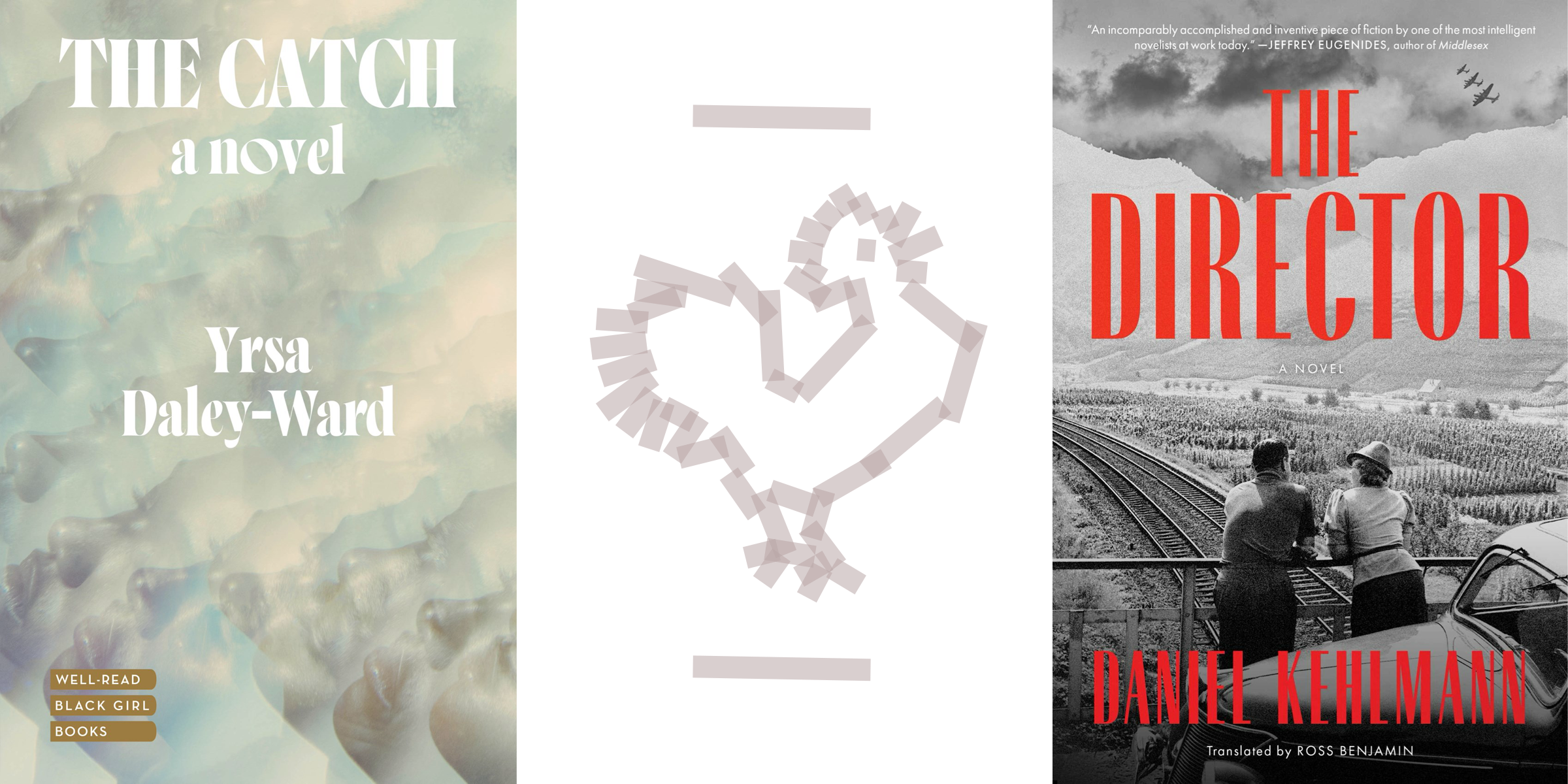
The Catch
v. The Director
Judged by Natalie Shapero
Natalie Shapero is the author, most recently, of the poetry collection Stay Dead, long-listed for the National Book Award and shortlisted for the TS Eliot Prize. She lives in LA and teaches writing at UC Irvine. Known connections to this year’s contenders: “Angela Flournoy is my friend.” / natalieshapero.com, Instagram
Before I begin, I’ll just note that, when I’m choosing novels for myself, I read basically exclusively contemporary realist fiction. I think this is because I often feel, at a very basic level, like I do not understand the world in which I live, and I’m always grateful for a book that provides a sharp exegesis of what is already familiar to me but has not yet become legible. I favor snappy writing and social critique within a page-turning story arc; I’m not a critic of fiction (nor a writer of it), so I’ve grown annoyingly accustomed to reading for the near-exclusive purpose of having intellectual experiences that I curate for myself, before bed or out in the sun, as a break. So, when the Tournament began and I received in the mail one book of speculative fiction and one book of historical fiction, I felt mildly—disappointed? Stymied? Out of my depth—or, if not my depth, at least my element? But I can say, now on the other side, that I very much admired both of these books. That isn’t to say I enjoyed reading them—they’re actually both quite unfun reads—but they’re two very skillful works, and I could see a strong case for either one surging forward.
The common theme across the two books that really stood out to me is confusion. In The Catch, a thorny and vibrant novel that operates in defiance of traditional understandings of time and space, characters are often fundamentally unsure what is going on, who they’re with, and sometimes even who they are. This novel follows twin sisters who were abandoned young by their mother, raised in separate adoptive households, and then, as adults, become entangled with a troubled stranger who looks just like their mother, is the same age she was when she disappeared, and might in fact actually somehow be her. Almost every experience in the novel is filtered through memory, time, literature-within-literature, and/or social media, leading to conflicting accounts of the past (and the present… and the future?!) and an electrifying sense of cosmic recursiveness. The book is also bold and sharp in its explorations of violence and sexual exploitation as well as racist constructions of beauty and femininity in the lives of these Black leading women. Finally, The Catch was a very satisfying stealth literary exploration of contemporary food culture, with one twin being all about the delivery apps and another deep in the discipline-happy world of the pre-packaged and pre-portioned.
FROM OUR SPONSOR

The Director also often operates through lenses of confusion. Characters struggle with age-related cognitive decline, language barriers, mandates to speak in and understand bureaucratic codes and euphemisms, a head injury of disputed origin, and the general condition of being a child without full access to the world of information. Originally written in German by Daniel Kehlmann and translated into English by Ross Benjamin, this historical novel follows the life of Austrian filmmaker G.W. Pabst, tackling questions of artmaking, family responsibility, and the costs of survival in Nazi Europe. This book does a particularly effective job dramatizing the increasing shocks of reactionary takeover and the flipping of existing power balances. It’s extremely chilling (and convincing) in its narration of uncertainty as to whether to stay or go as fascism escalates its hold; the depiction of characters realizing too late that the borders have closed and they can no longer leave is pretty unshakeable. I have to admit my own shortcomings here in not having seen any of the films referenced in the novel, and I suspect (again, my own failing, and not the book’s) that there are dimensions of the story that were lost on me because of my regrettably shoddy grasp on World War II-era film history, but I found it to be a genuinely edifying and also productively upsetting book of fiction.
Ultimately, though these two books are very different, they made for a compelling read as a pair. They’re both interested in questions of safety, both at individual and systemic levels, as well as attendant questions of culpability and compromise. They also both aggressively switch perspectives as they go along—something I don’t personally prefer in a novel, but definitely a device that allowed each writer to show off their character-development chops in a deep way. Both novels made me, at times, feel literally physically ill, a testament to both how viscerally they evoked their difficult subjects and also to the way each book’s formal innovation conjured a deep feeling of lostness and a despair both localized and existential. The question of which to advance was definitely a close call, but it ultimately came down to a few things for me. First, I just think the premise of The Catch is genuinely potent and piercing and strange in a way I hadn’t encountered before. I also hope I can say without really doing a spoiler that the ending is (or at least encompasses) a very satisfying and complex meta-gesture. I appreciated both books very much, but points to Daley-Ward for a very inventive and risk-taking work that feels like it exists both out of time and—thanks to deep dives on influencing, parasocial relationships, and (I think?) the only literary representation I’ve ever seen of second-screening—very much in the contemporary moment.
Advancing:
The Catch
Match Commentary
with Kevin Guilfoile and John Warner
Kevin Guilfoile: I am writing this the day after the State of the Union and there is a lot of debate about the US men’s and women’s hockey teams and the manner in which each of them dealt with the politics of their wins—the women’s team declining an invitation to the speech, and the men’s team (at least most of them) accepting it. Regardless of the individual politics of the players, they have all worked hard to be in a position to represent their country, and they don’t control who the president is when it’s their turn, so while I was heartened by the stand taken by the women, I also don’t begrudge the men who made a different decision. This is a predictable part of their victory lap, and every president exploits championship athletes for their own political gain.
Watching the way Trump used them as part of a nationally televised propaganda spectacle, however, had me thinking a lot about The Director, which specifically addresses the dilemma of being an artist under a fascist dictatorship (or in the present case, a wannabe one). Stuck in Germany after the borders are closed in the wake of the Nazi invasion of Poland, Pabst, largely politically agnostic but no Hitler stan, just wants to make films, and the Propaganda Ministry assures him he can make whatever movies he wants to—he doesn’t have to make films specifically glorifying the Reich. But, of course, Pabst’s films about ordinary Germans going about their lives—films similar to those being made in Allied nations—are used by the Nazis in an attempt to demonstrate to the outside world that things are just fine inside Germany. Pabst’s normal films are used by Hitler to normalize the Nazis.
The US men’s hockey team was used by Trump exactly the same way. He knew that even his political foes would stand and applaud for them as he directed the drama from the podium. He made their glory his. And in doing a thing almost any president would do, he tried to make his corrupt, murderous, war-making regime seem normal.
John Warner: I was less bothered initially by the men’s team accepting the Trump invite than I was Kash Patel somehow joining the locker room victory celebration like the world’s most entitled Make-A-Wish kid. I grew up playing hockey and continued on into my adulthood in a men’s rec league, so I’m no stranger to the general political orientation of the sport, but I thought we all drew the line at embracing third-rate podcaster dorks.
The pressure test of fascism as rendered in The Director, what Judge Shapero identifies as the theme of “culpability and compromise,” is awfully present on a daily basis here in the USA. The things we are willing to ignore or sacrifice to get or retain something we desire is potentially bottomless, including the loss of our very freedom. This couldn’t be more apparent in an area where I spend a lot of time and effort—higher education—where many people who lead these institutions capitulated to Trump because they feared he could make it so they could not do their work.
We learn in The Director that these compromises never really stop. Responding with feeling a sense of despair, as Judge Shapero does here, seems only natural.
When it comes to The Catch, it is my co-champion with Metallic Realms for the prize of writing a book that seems to come from an idiosyncratic and uncompromising vision. Even describing it as “strange” does not quite do it justice, and in this case, it appears to be that uncompromising vision that puts it over the top.
Kevin: The premise of The Catch is quite (David) Lynch-ian—as I tried to orient myself when reading, my mind went often to the film Mulholland Drive—and like Lynch’s signature style, Daley-Ward has a vibe all her own. It’s evident from the first pages that you are reading something different. That there is something under the surface here, waiting to be discovered by the reader.
Throughout the novel I tasted bits of Martin Amis and Joseph Heller and Octavia Butler and Madeleine L’Engel and even the Choose Your Own Adventure books, although it’s also not like any of those things. John, I’m sure you could come up with a precedent for the way Daley-Ward sometimes shifts into poetry and then back to prose again, but I couldn’t think of one. I thought it was thrilling to read.
I give a lot of credit to Judge Shapero who, when forced to choose between a pair of books that were, maybe, not her usual tea, she went with the one that felt the most different, the one that was trying to show her a persepective—a vibe even—that was unfamiliar to her. The one that unsettled her. That says volumes about her as a reader.
John: I would’ve gone the other way on this matchup, personally, I think, though the discussion of The Catch has increased my appreciation of it. I don’t know that I was resistant to it, exactly, and I appreciated its DGAF orientation, but I never quite locked in with it. Credit indeed to Judge Shapero for taking to the unfamiliar with such enthusiasm.
Kevin: The Director was one of my favorite novels in the tourney this year, a book that speaks directly to our present time. There also were a few things about The Catch that didn’t sit right with me. You know I think there are too many novels with writers as protagonists—writers know how uninteresting the lives of most writers are, and Clara’s writer life was almost comically too interesting. Also, I didn’t love the ending as much as Judge Shapero. But reading it felt like a discovery, which isn’t a feeling I get very often.
The merch table is open
Your purchases help support the Tournament of Books—plus, get 50% off all items when you become a Sustaining Member.

Show your allegiance to literary bloodsport. Plus, receive a 50% discount on this item and everything in our store when you become a Sustaining Member.
Ceramic / lead and BPA-free material / Dishwasher and microwave safe / dimensions: 11 oz (3.8" height, 3.2" diameter), 15 oz (4.7" height, 3.3" diameter)