
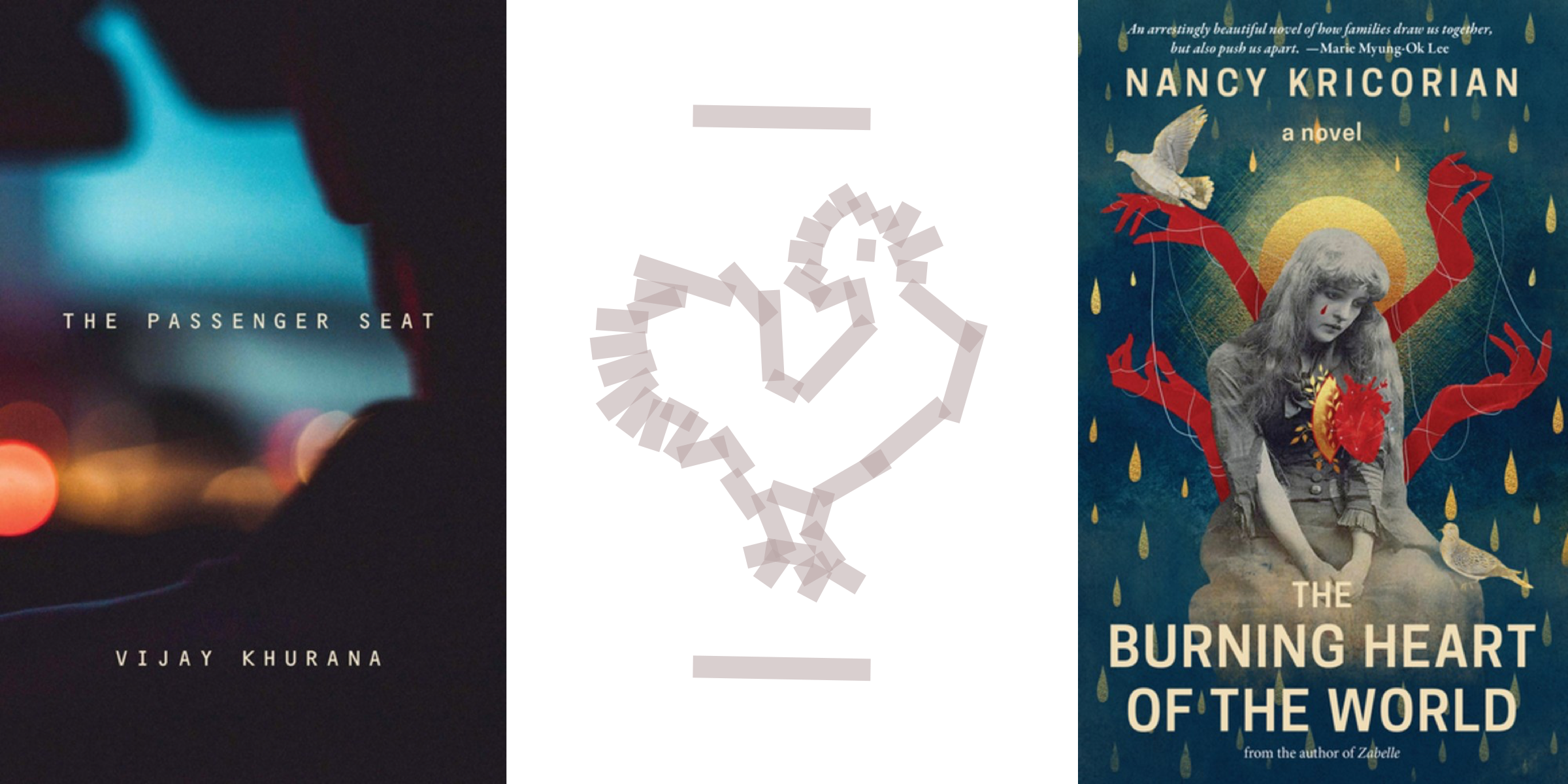
The Passenger Seat v. The Burning Heart of the World
presented by

MARCH 27, 2026 • ZOMBIE ROUND
The Passenger Seat
v. The Burning Heart of the World
Judged by Leon Hendrix
Leon Hendrix III is a writer, director, and producer who has developed TV projects, written films, and worked in TV writers’ rooms for Netflix, Warner Brothers, Apple, Paramount, Universal, Amazon, HBO, and Lionsgate for nearly a decade. Recently, he was a Producer on Kurt Sutter’s Netflix western series The Abandons, and he’s currently in post-production on his first feature film as a director. Whenever he’s not writing TV and film, he teaches all things film and TV for programs such as Columbia University Film, Hampton University, Northwestern National High School Institute, and Ghetto Film School and Inner City Arts; travels the world; hikes; hunts; and explores the outdoors. Known connections to this year’s contenders: None.
The Burning Heart of the World and The Passenger Seat are both novels about teenagers verging on young adulthood.
Both stories follow characters struggling to grasp the ebb and flow of the sometimes hypocritical codes that govern adult morality. Both stories follow their protagonists through the confusing mire of milestones and often humiliating rituals that make up the transition from girl to woman, or boy to man (if such transitions ever take place).
Both books ask questions of us—timeless (how long can a teen boy go without washing his balls? What’s the best way to hold a cigarette for maximum rizz?) and urgent (what’s the use of morality if it traps you in a purposeless pantomime? Who are you when stripped of your home, your flag, your language?).
And here is where the stories begin to diverge.
FROM OUR SPONSOR

Nancy Kricorian’s novel, The Burning Heart of the World, is a beautiful, sad, and paradoxically halcyon look at a turbulent time in the lives of a girl named Vera and her family, caught in the literal and social minefield of Beirut during the Lebanese Civil War.
It is a laconic stroll through Vera’s life in a warzone, which doesn’t seem an impediment to a proper teen girl’s coming of age. Vera’s adventures as a romantic surrogate for her cousin Nora (the kind of girl church folks would call “fast” back when I was a kid), or sweet friendship with the athletic, cute Alex, are juxtaposed with her parents’ battles over the future of the family and her brother’s growing performance of reckless bravery and ultra-national pride. Vera maintains a child’s perspective, never setting her sights above makeup, boys, friends, and her sketchbook.
Family conversations are appropriately tense. People are displaced. Killed. Homes and businesses bombed and seized. It isn’t that these scenes are unimportant, they simply don’t feel most important to Vera. Mind you, this is not meant to trivialize Vera’s concerns. Only to impress that she may not share the reader’s perspective or fears. When her parents begin to question if they can even stay in Beirut, Vera laments the loss of her newly acquired boyfriend (they only just made it official!). This is not an accident. The battles and bloodshed are not something that happen to Vera, so much as things that happen around her. Medz Mama sums it up best: “It was too heavy a burden for a child.”
Burning Heart evokes the patient, winding road an anxious girl takes on the path to becoming a woman. The violence—the plot—does ramp up as the family’s choices and community dwindle, but even as she faces her greatest loss, Vera maintains a hold on the magical naivety of girlhood. Vera exhibits a kind of benign resilience, not exactly in opposition to the world around her. It is admirable. Almost nostalgic—if only we could protect the innocence of all children this way. But it’s a mellow read, and, if I must make a choice, not a compulsory one.
On the contrary, there is an ugly, creeping rot in The Passenger Seat. Like blood poisoning. Like regret. It stinks, swears, and begs to be witnessed.
Vijay Khurana’s writing centers the internal emotional experience of Adam and Teddy, the central protagonists, over the world around them—but it all feels so much more tense. Like a glass on the edge of a countertop.
It’s a feat considering the emptiness of the novel. That’s because Khurana’s boys don’t live in spite of the world. They live to spite the world. And to be seen spiting it.
Adam and Teddy are on a road trip. Why? It doesn’t matter. Then sometimes it’s the core of their power struggles. Words unspoken. Vile, violent thoughts. Petty insults and mean-spirited pranks. Where are they going? The Arctic, if you really care. And the hot springs. But the real goal is to “get the fuck.” To cross a boundary. Escape. Go anywhere that decency, demands and desperation can’t follow.
They kill, steal, and lie. The Passenger Seat observes this all dispassionately. There is a chilling tension born of their predatory logic spilling out into a world full of hapless minders-of-their-own-business. When Adam urges Teddy on with a vicious vagueness: “Let’s fuck with them.” One part catchphrase. One part core philosophy.
The boys fancy themselves thinkers. Adventurers. Rebels. Men.
Whatever the hell that means. This is a performance of a script made of the fragments of fallacies, misconceptions, and whatever grifter shit they read in “the book.” A pinch of sexism. Xenophobia. Violence. A sexual thrill at the thought of further violence. You could mistake them for some grand malevolence. Except there is a forced casualness to their anti-social competition. They are callous to be certain, but only as a means to obscure the desperation inside.
It’s a snail race to the bottom of their souls, only to prove they can go lower. They revel in dehumanizing and destroying (victims, each other, themselves?), but their violence is absent ill intention, holding only ill-considered impulse.
They are the distorted offspring of MTV’s commercial rebellion, the cynical exhaustion of millennials and the nihilism of the AI age. A tribute band for Cobain and Rittenhouse.
There are no devils here. Only a space where a heart should be. Or fear. Or something. Their feelings are fleeting. Always unreal. And that unreality gnaws at them.
You won’t see terror in the homoerotic intimacy kept at arm’s length, in their petulant urge to be seen as some kind of fearsome folktale, in the frustration and inadequacy that gives rise to their violence. You will see doubt. You will pity their farce. You’ve known boys—and men—like them.
They are a problem we must solve. We must see them for the empty, ugly, petty lot they are, wishing to scar the world with their memory, just to be remembered. If that and only that has been accomplished here, it’s a thing everyone should witness. And a book everyone should read.
Advancing:
The Passenger Seat
Match Commentary
with Meave Gallagher and Alana Mohamed
Alana Mohamed: There is more heart and sweetness in The Burning Heart of the World than The Passenger Seat, so I guess I can see how Judge Hendrix might read it as more mellow than the disembodied, blood-soaked road trip of The Passenger Seat, but it’s certainly not without its dangers!
Meave Gallagher: I spent most of Burning Heart’s Beirut scenes bracing for Vera or Nora to be raped, or Vera’s father or one of her brothers to be murdered. In Passenger Seat, I felt as little for Adam and Teddy as they seemed to feel for themselves.
Alana: Yes, I was completely held by that fear for Vera and her family the entire novel—while also deeply worrying that she had to leave her first boyfriend behind! I thought The Burning Heart of the World did such an amazing job of making us feel the devastation of war in these small moments just as much in the big ones. It is no secret that I also enjoyed The Passenger Seat, so I think I felt more for Adam and Teddy than you did. I would have been happy to see either book move on.
But I must reiterate my feeling that Khurana is specifically writing not to exceptionalize Teddy and Adam’s violence but to trace it back to American society. If Teddy and Adam are an “empty, ugly, petty lot” it’s because they are of an “empty, ugly, petty lot.” To your earlier point in the quarterfinals, put them in reeducation camps to what? Age into quieter forms of misogyny, as depicted by the end of the book? I feel like the novel is saying that if we start and end our diagnosis with Teddy and Adam, we’ll just reproduce more of the same.
Meave: If you and Khurana are going to indict all of us for every Adam and Teddy and Charlie Kirk and Nick Fuentes and Clavicular and Adin Ross and Fresh and Fit and their multitude of followers, I will quote lavishly from this excerpt of Dr. Frederick Haynes III’s sermon following the murder of Kirk:
And you going to say, “We better than this.” No. You can’t fix what you won’t face until you look in the mirror and say, “This is a violent country that has done violence to many people.” … “Come on, we better than this.” No, we ain’t.
This would be a reeducation course, but Dr. Haynes will be busy running for congress in Texas’s 30th district, which we, as of this writing, very much want him to win.
Since my beloved Burning Heart has been yet again discarded, I will continue to offer jewels from the world of Kricoriana: Here she provides further context to the real Bourj Hammoud and the fictional Nor Hadjin. Allow me to use her own words to argue for the novel’s timeliness and timelessness—qualities some (me) might say outlast urgency?
My novel… appears at a time when Lebanon and Armenia have just experienced more paroxysms of violence, suffering under existential threats to their sovereignty and territorial integrity… The title evokes both illumination and conflagration. The world is on fire, and while there is much darkness in the book, there is also humor, empathy, and a commitment to amplifying that which is humane in the human. This last is central to my literary project.
And, I might add, presumably to her life’s work, which I’ll say again, anyone interested in how access to literature and learning to write can be forces for justice should follow Kricorian’s work in Occupied Palestine, among other places.
Alana: I do love it when you drop some Kricoriana. When she talks about the balance of darkness and the humane, I go back to all those small moments in Vera’s life, the ones that the adults might dismiss as unimportant, but are just as formative. That being said, I found The Passenger Seat achieved something similar—though whether readers think its main protagonists deserve that is a different question. I read it twice and I fear I will reread it again because of our conversations, Meave. But who knows, god willing I’ll revisit it in 20 years and find it has aged poorly!
Meave: At this point, I feel like I’ve said all I can say about any of this. Men gonna boys (see the last two chapters of Passenger Seat). Women and girls gonna carry a heavier weight and do it uncomplainingly, how dare you complain, are you unwell? The “Turkification” of “Greater Anatolia” didn’t end until around 1922—lol jk it’s still happening justice for Artsakh (Nagorno-Karabagh). There is never an end to history because people are always making it.
Alana: With that, The Passenger Seat moves into the final. On Monday, Judge Katya Apekina will choose whether Endling’s revivified snailsor the still-fresh Flesh will advance with it, and Kevin and John take the booth. Will women and girls catch a break?
Meave: In this economy?
The merch table is open
Your purchases help support the Tournament of Books—plus, get 50% off all items when you become a Sustaining Member.








Wear your allegiance to literary bloodsport with pride. Plus, receive a 50% discount on this item and everything in our store when you become a Sustaining Member.
Unisex fit / soft and lightweight / 100% combed and ring-spun cotton (heather colors contain polyester)