
The Passenger Seat v. The Wilderness
presented by

MARCH 25, 2026 • SEMIFINALS
The Passenger Seat
v. The Wilderness
Judged by Danny Abel
Danny Abel is a documentary director and editor based in Echo Park, Los Angeles. His most recent film, The King of North Sudan, was produced by Rough House Pictures (Danny McBride, David Gordon Green, Jody Hill, Adam Bhala Lough) and was distributed in over a dozen countries. His recent editing work includes blur: To The End and Liam Gallagher: Knebworth ’22, which premiered in cinemas worldwide and on Sky Arts and Paramount+, respectively. His current film, Made for You, explores romantic relationships between humans and their AI companions. Known connections to this year’s contenders: None. / goodmotorist.com, Instagram
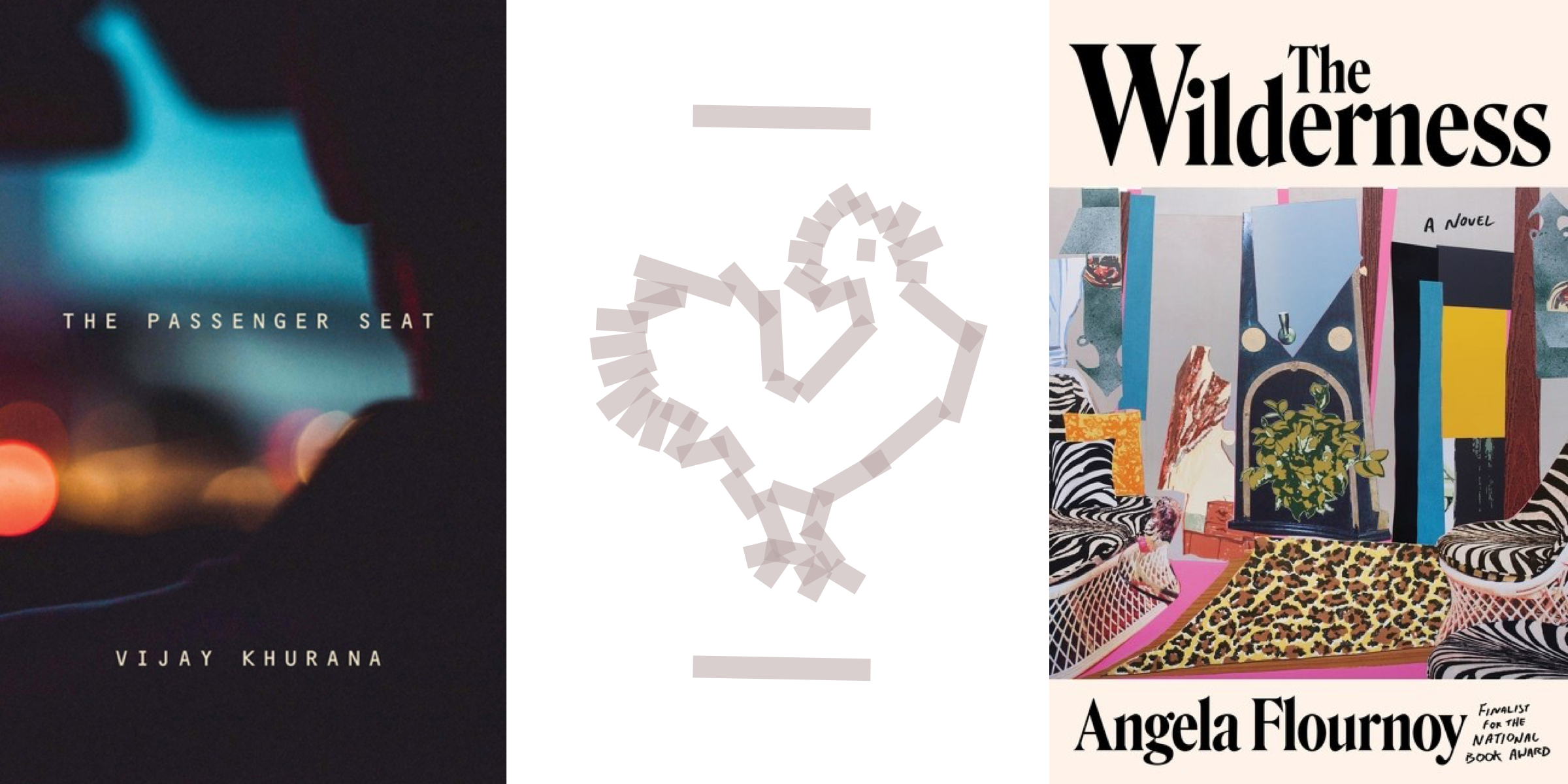
The Passenger Seat by Vijay Khurana and The Wilderness by Angela Flournoy are both novels about friendship, but they provided opposite experiences for me as a reader. Khurana’s men communicate through brutality and raw need; Flournoy’s women through wordless coordination and mutual support. One friendship is corrosive and dangerous. The other is aspirational, almost utopian. I knew immediately which group I’d rather know in real life. And yet the friendship I understood—the one whose emotional logic I could actually follow—was the one I’d never want to be part of. Which says something about the book. Or maybe about me.
The Passenger Seat follows two boys—Khurana toggles deliberately between calling them boys and men—on a summer road trip from British Columbia into the northern wilderness. The novel follows a hero’s journey, sharing DNA with road trip classics like On the Road, Fear and Loathing in Las Vegas, Harold & Kumar Go to White Castle. All of them riff on the road-trip-as-masculinity ritual—boys stripping away everything familiar to discover who they are and transform into men. But where On the Road captures the joy and spiritual freedom of being young, The Passenger Seat focuses on the discomfort—the bleeding backne, itchy and pungent genitals, hot anger, pulverizing insecurity. The cruel specificity of language like, “He has a messy comb-over the colour of come and wet eyes with which he tells the world he has given up,” makes it hard to put the book down. But once you do, it makes you want to wash off—if not in the shower, then via water bottle squirted into your pits and down your shorts, like Khurana’s young anti-heroes.
FROM OUR SPONSOR

The first chunk of the book felt uncomfortably familiar. Affection shown through a punch to the thigh. Horniness so intense it becomes physical pain. The elation of blowing someone’s brains out in a video game. Wordless codes of conduct—always enforced, impossible to appeal. And then the book takes a shocking and violent turn. This wasn’t a “growing pains” book after all—it was of the “men are NOT all right” variety. And I had to pause and consider, “Am I toxic?” I hope not! But the book’s final section makes clear this whiplash was intentional. And maybe the only thing separating this amateur book reviewer from someone capable of real violence is random luck—that my teenage body never stumbled into the particular dangerous situation where my destructive impulses temporarily overwhelmed my better judgment (as they often did!)—and my whole trajectory changed in an instant. It is a chilling proposition.
The Wilderness tracks five Black women across two decades of friendship, careers, relationships, and motherhood. The novel’s sharpest observations are about group dynamics—the silent choreography of women moving in relation to one another. One of my favorite scenes takes place on a night out.
The women, if they focused, could dance with one another while also nominally dancing with the men. They led. Eye contact between women could switch everyone from winding to two-stepping, from being paired off to a tight, partner-free circle.
I was right there, tracking the laser of their silent messages. I’d never seen that dynamic captured in prose before, and it gave me that Rear Window thrill of witnessing a reality I had never had access to.
The novel has a sharp eye for performative progressivism—the coffee shop displaying photos of smiling bean farmers, the thirsty Instagram post. But the novel’s moral framework is frustratingly binary. It contrasts Monique, who exploits a run-in with structural racism for internet fame and fortune, with Nakia, who runs a James Beard-winning café called Safe Harbor and feeds the homeless on her days off. The Wilderness gives Monique almost no interiority—her story is told entirely through excerpts from her sanctimonious online essays. It’s a formal choice that suggests a certain contempt: Monique’s grandstanding speaks for itself, we don’t need to waste time looking under the surface. For a writer skewering the vacuousness of a certain terminally online racial discourse, denying Monique psychological complexity commits the same sin she’s diagnosing.
The book is written in close third person, tracking the minutia of life’s rituals. But I always felt like I was on the outside looking in. Desiree engages in a sexual relationship with a man in order to hurt an estranged family member. This is juicy stuff! Revenge sex with narrative consequences! But The Wilderness describes the action without inhabiting the contradictory impulses that would drive someone to do this. We get the event and the broad motivation—revenge, transferred grief—but not the emotional logic in real time. What does it feel like in her body when she makes that choice? What does she tell herself? How does she justify it, or does she? The Passenger Seat’s protagonists also lack self-awareness, but I understood their emotional math. I recognized one book’s contradictory impulses; the other’s I found illegible.
The Wilderness was named a “Best Book of the Year” by the New Yorker, NPR, Vogue, Elle and TIME. (Who knew all these rags had book critics? The novel isn’t dead after all!) Barack Obama placed it on his famous list. But for me—a middle-aged, stubbly, cereal-milk-complexioned reviewer—it didn’t land. I recognized The Passenger Seat’s vernacular of violence and need, and felt alienated from The Wilderness’s rote gestures of solidarity. Is that the fault of the writer or reader? Can you trust a white guy’s assessment of a book like The Wilderness? I don’t have an answer. But I do have to pick a book, and I choose The Passenger Seat. Yes, I understood its emotional language more readily. But I also think it takes greater formal risks—the slow build toward violence, the deliberate discomfort. The Tournament makes visible what’s true of all criticism: we’re forced to render judgments when we can never be sure of the limitations of our own subjectivity.
Advancing:
The Passenger Seat
Match Commentary
with Kevin Guilfoile and John Warner
Kevin Guilfoile: Obviously, we didn’t plan for these books to meet here in the semifinals, but has there ever been a Rooster matchup with a more compelling contrast, one that meets the cultural and political moment, the way these two books do?
The Wilderness has pretty much coasted to this point, and it’s easy to see why. Flournoy is a beautiful writer and her vision of Black female friendship is appealing and exciting. Today that idealized vision ran into the harsh exposure of a contemporary male friendship and Judge Abel picked the one that was more difficult to read but harder to turn away from.
ToB sponsor Field Notes has a periodic newsletter called Staple Day and as I was just now typing, the latest one landed in my mailbox. It is filled with FN news, but also thoughts and observations by Field Notes co-founder Jim Coudal. And today he included a quote from novelist Robert Stone:
There’s only one subject for fiction or poetry or even a joke: how it is. In all the arts, the payoff is always the same: recognition. If it works, you say that’s real, that’s truth, that’s life, that’s the way things are. “There it is.”
I know some people don’t like reading books like The Passenger Seat. There are some who feel that reading yet another thing about the “masculinity crisis” asks them to feel empathy for privileged assholes who mistake themselves for victims because they are being asked to give a shit about anyone else for a change. I get that. In the year of Marty Supreme there is no shortage of narratives about terrible men, and I would much rather read about Desiree and Monique than Adam and Teddy. But The Passenger Seat identifies a disease in young white men and that disease affects all of us. Mass shootings affect all of us. Domestic violence affects all of us. Hate crimes affect all of us. The epidemic of sexual assault affects all of us. The poisonous memes of the online manosphere affect all of us. The normalization of racism affects all of us. There is a toxic white male heading the Dept. of Defense. There is a toxic white male running our immigration policy. There is a toxic white male in the White House, and on his orders a few weeks ago, almost 200 Iranian schoolgirls, none of whom, almost certainly, had even heard the term “masculinity crisis,” were killed at the other end of a Tomahawk missile because of it. We need to diagnose the disease, and then we need to find a cure for it.
Judge Abel got to the end of The Passenger Seat and said to himself, “There it is.”
John Warner: For years I’ve had a mostly, but not entirely joking idea for a companion novel to On the Road that would be written from the points of view of the people who Sal and Dean encountered on their travels. I’d title it Who Were Those Assholes?
Kevin: I am a little bit angry that you didn’t ask me to write that with you 25 years ago.
John: The 70th anniversary of On the Road’s publication is next year. Hit us up publishers, we’re ready!
There’s a romantic cast to the road trip adventures of those other stories Judge Abel invokes, but isn’t there some part of the boys/men in The Passenger Seat in those narratives? Do we solve this problem with empathy? With sympathy? With tough love? With force? The personally aggrieved thwarted male has always been present, but now it is something like a movement, and it has been yoked to politics. There’s this 31-year-old guy running for governor in Florida who is essentially trying to troll his way into office with right-wing memes and antisemitism. His extremity is the attraction, and the primary attractants are young men. There is a young woman in the story I linked who is a case worker for foster children and also a Zohran fan who is considering voting for this freak.
A guy comes along and says he’s going to end the “corruption” of elites, and oh, by the way, “it’s the Jews,” and he attracts a following significant enough to be profiled in the New York Times. It’s absolute madness, but what isn’t these days?
Kevin: So what gets us closer to a cure: diagnosing the disease, or taking the antidote? I am worried that too many people still don’t see what is already upon us. Our entire government is being directed by Hegseths and Millers and Voughts and Bannons and Trumps, men who were considered extremist clowns 15 years ago. If we ignore it, if we allow ourselves to indulge in the fantasy of an alternative reality, does that inoculate us from their buffoonish malice, or does it normalize it? I have no idea.
John: It’s incredibly dangerous and there appears to be no authority capable of coming along and saying, “Cut the shit,” to shut it down, and no structural change on the horizon that would give people attracted to the conspiracist populist something else to hope for.
In a way, The Wilderness is a novel about a group of Black women banding together as a form of protection against these forces, finding some measure of insulation with their success and solidarity. The concluding chapter, set in 2027, shows how little that insulation offers against systemic, careless violence. When I read it, it shook me. As I think about it, it shakes me again.
Kevin: Sadly, The Wilderness does not have the votes to advance to the Zombie Round. If the Zombies were held today, The Burning Heart of the World and Endling would be our Only Mostly Dead Wesleys.
The merch table is open
Your purchases help support the Tournament of Books—plus, get 50% off all items when you become a Sustaining Member.

Wear your allegiance to literary bloodsport with pride. Plus, receive a 50% discount on this item and everything in our store when you become a Sustaining Member.
Faded black, six-panel low-crown cap with a curved visor and buckle back / one size fits most / 100% cotton material