
Flesh v. Endling
presented by

MARCH 30, 2026 • ZOMBIE ROUND
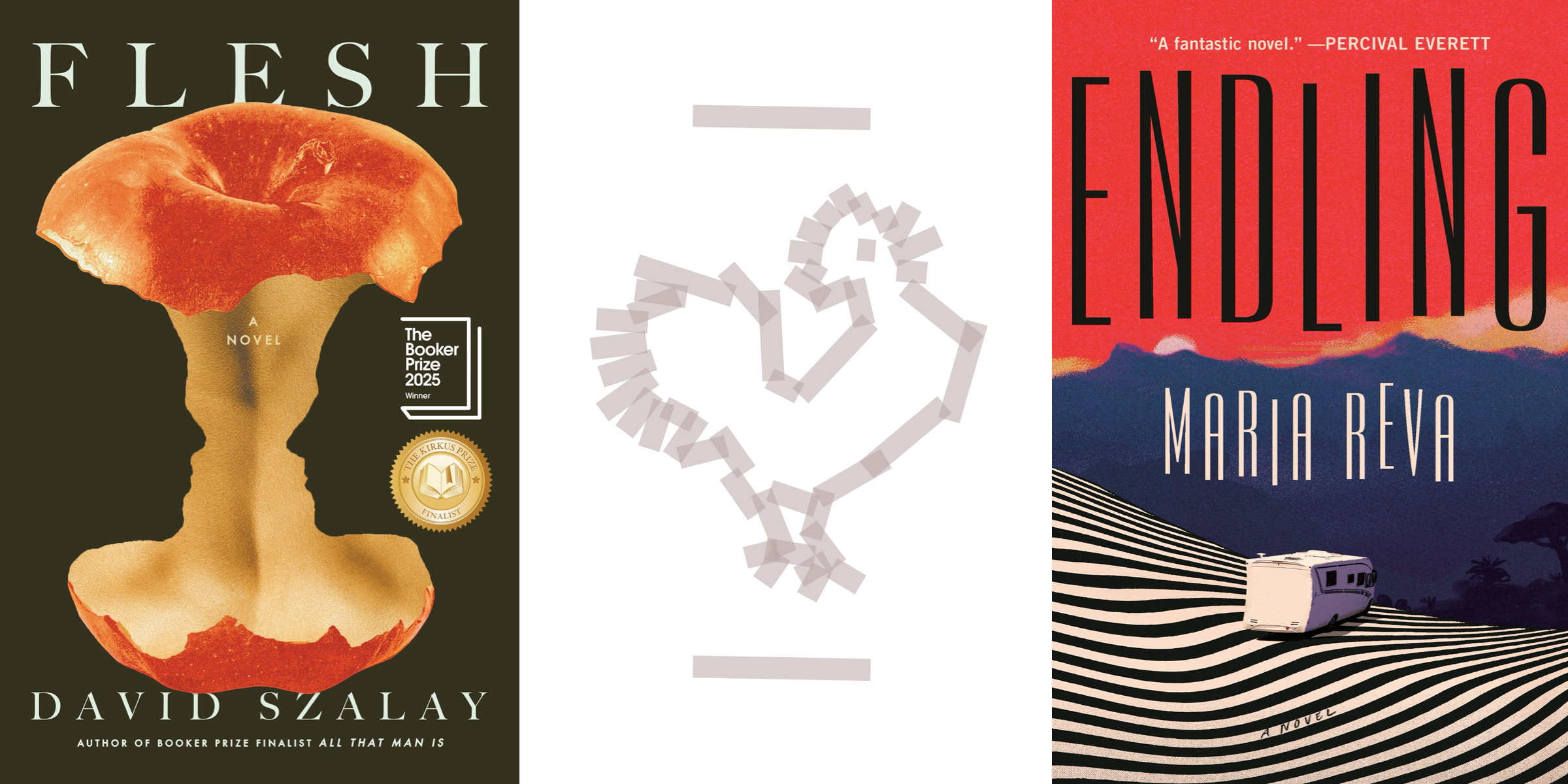
Flesh
v. Endling
Judged by Katya Apekina
Katya Apekina is a novelist, screenwriter and translator. Her debut novel,The Deeper the Water the Uglier the Fish, was named a Best Book of 2018 by Kirkus, BuzzFeed, LitHub, and others and was a finalist for the Los Angeles Times Book Prize. Her second novel, Mother Doll, was named a Best Book of 2024 by Vogue. She translated poetry and prose for Night Wraps the Sky: Writings by and about Mayakovsky (FSG, 2008), shortlisted for the Best Translated Book Award. Born in Moscow, she grew up in Boston, and currently lives in Los Angeles with her husband, daughter, and dog. Known connections to this year’s contenders: None. / apekina.com, Instagram
I was told not to say that these books are difficult to compare, but they were! Flesh felt like a sleek bullet, tearing through my body. Endling felt like an overstuffed suitcase, exploding joyfully, sadly, humanely, messily. Some of their themes even overlapped, eastern European masculinity and sadness. But their intentions seemed so different. So, I guess, I am judging each in a way against itself.
In terms of the reading experience—Flesh felt like a smooth, more controlled ride. I was definitely in a luxury vehicle. But where was I being driven to? And why didn’t the doors open from the inside? Several scenes made me feel like I, the reader, was about to die. I was in such a heightened state of tension, it was physically painful to read—and of course the genius of it is that it was in scenes where absolutely nothing happened. It made me feel like a basketcase.
As soon as István is given something to love in the form of a son, I immediately thought “Oh shit.” The son is Chekhov’s rifle hanging on the mantle waiting to go off. The author would only give him this boy to love so he could then take him away. And it feels like the author knows that the reader knows this, and there’s a certain pleasure he’s taking in fucking with us.
In the scene where István is teaching his boy to ride a quad bike—I wanted to crawl out of my skin. Under all the words the literary equivalent of menacing music. Building ambient dread. How does he do that? Nothing happened, but you knew something was coming. It was inevitable. See, the author seemed to be saying, this is the pain of loving! It’s unbearable. You will always be waiting for the other shoe to drop! It will always hurt! Is that a particularly Eastern European sensibility? I don’t know. As someone raised in that tradition, it’s maybe hard for me to see outside of it.
FROM OUR SPONSOR

It’s funny, because Endling is metafictional and has the author as a character, Flesh does not, and yet it’s in Flesh where I could feel the authorial puppet master presence. Endling is set in Ukraine and it’s about the war, but it doesn’t have this post-Soviet darkness. It feels like it’s written from a hopeful perspective of an immigrant, trying to understand things that are both fundamentally close and fundamentally foreign at the same time. Endling feels hopeful. It’s funny. It uses humor to cope with the horror of war. To look at the horror, it nibbles around its edges. It uses a trojan horse—or an RV full of men who came to Ukraine to meet docile East European wives. It has it all: endangered snails, an asexual Eve, a Ukrainian immigrant from Canada coming to reconnect with his homeland, yurt makers engaged in arguments with the author about the nature of truth and fiction and the making of meaning. It does not try to reduce the complexity of the feelings and situations involved in any of it—it accepts the messiness of being alive.
If Endling was a ride, it would be a Lyft where the driver is eating a sandwich, swerving left and right, pointing out sights, but somehow not careening off the road. The drive would be a slow one, but also memorable, lovable, funny, humane etc.
I did not feel like I was being led on a short leash, as I did with Flesh. I felt like I was wandering around in a slight state of befuddlement and confusion. The emotional impact was muffled, but that is also because how can one truly understand something so painful? There’s a protective mechanism in most of us that teaches us to look away. When Pasha went on a walk and found a severed hand on the bridge, and then convinced himself that he had seen a glove—this is maybe an operative metaphor for how the book functions as well. A glimpse of something awful and then a papering-over, a retreat, a revision because the truth is unbearable. So, in a way, both books really are about something very similar: avoidance of emotional pain that is too big to fathom.
Though Endling is about war, Flesh ends up feeling somehow so much sadder. It’s about the tragedy of male blankness, of a character who is emotionally inaccessible to himself. The sexual abuse and traumatic accidental death at the beginning shapes his whole life—at the end when he cries and does not even know what it is he feels, it’s completely gutting.
Flesh advances to the next round.
Advancing:
Flesh
Match Commentary
with Kevin Guilfoile and John Warner
Kevin Guilfoile: Wow. So in a case of art imitating the timeline we are all stuck in, The Rooster will have an all-male-alienation final. One book examines the rot from the perspective of a decision from which two young men can never return, and the other follows it over the course of a man’s entire life.
John Warner: I am frankly stunned by this final. I thought at some point a judge would have the kind of response I think a number of commenters have expressed, essentially, “Enough already with these boys/men.”
Maybe it’s just too hard to escape the zeitgeist, but it’s also clear that all of the judges have found merit in the books. I don’t want our repeated circling around the subject matter of Flesh (and The Passenger Seat) to distract from the fact that these are both skillfully rendered novels, and Flesh did win the Booker Prize. The authors set out with intentions and fulfilled them, and at least within the structure of this annual exercise, they’re finding favor.
Kevin: I love Endling, but you get the feeling that maybe it’s been overtaken by events. The metafictional parts of it seem to be, in part, an attempt by Reva to acknowledge that the world has changed in profound ways since she started writing it, while still standing by the premise.
John: This is a danger of writing close to the world as it is in a world as absolutely strange as the one we’re living through at this time. If someone at the start of his presidency had told me that Donald Trump was going to bomb Iran I wouldn’t have doubted it, but the specifics of the whole deal are just more bizarre by the day. How could fiction ever keep pace with this world?
Kevin: Flesh examines the damaged male psyche from a perspective that is pretty timeless, but The Passenger Seat seems rooted much more in the cultural and political moment. A recent New York Times essay by a pair of criminologists who study mass shooters could have been writing a review of that novel:
We are witnessing the emergence of a (new) paradigm: a mass shooter no less despairing about life’s hardships but younger, highly connected to online social networks and seemingly convinced that in acting violently he or she is carrying out the only meaningful act possible in a world otherwise devoid of meaning.
I wonder what it will be like to read The Passenger Seat 20 years from now. But I also wonder if its immediacy will help it or hamstring it in the finals match against a heavyweight success like Flesh.
John: Historically, in these kinds of finalist matchups the victory tends to go to the title with a larger pedigree heading into the tournament, but there are always exceptions, which is why I never have any courage behind my own predictions, but as of this moment, I’d give the nod to Flesh.
Kevin: In any event, the final is set with the internationally acclaimed, Booker Prize-winning Flesh taking on the Canadian indie The Passenger Seat. As always, thanks to our incredibly generous friends at Field Notes, we will run our prediction contest: Use the form below to enter your best guess for the championship result. There are 17 judges, but please note that one judge abstained from selecting a winner. So your prediction will take the form of The Passenger Seat, 10-6 or Flesh, 9-7, etc. We will choose two readers with an accurate prediction to win very awesome Field Notes Quarterly Subscriptions.
This poll is now closed. Thank you to everyone who voted!
And as we’ve done the past couple of years, we have the Henhouse, our people’s choice award. Cast your vote here, and we’ll announce our winner tomorrow.
This poll is now closed. Thank you to everyone who voted!
And we will be back here then along with Meave and Alana and the gang with our thoughts on the Rooster final!
The merch table is open
Your purchases help support the Tournament of Books—plus, get 50% off all items when you become a Sustaining Member.
Did you read all this year’s books? Show it off. Plus, receive a 50% discount on this item and everything in our store when you become a Sustaining Member.
High-opacity film that’s impossible to see through / fast and easy bubble-free application / durable vinyl / 95µ density