The 2026 Play-in Match
presented by

MARCH 6, 2026 • PLAY-IN MATCH
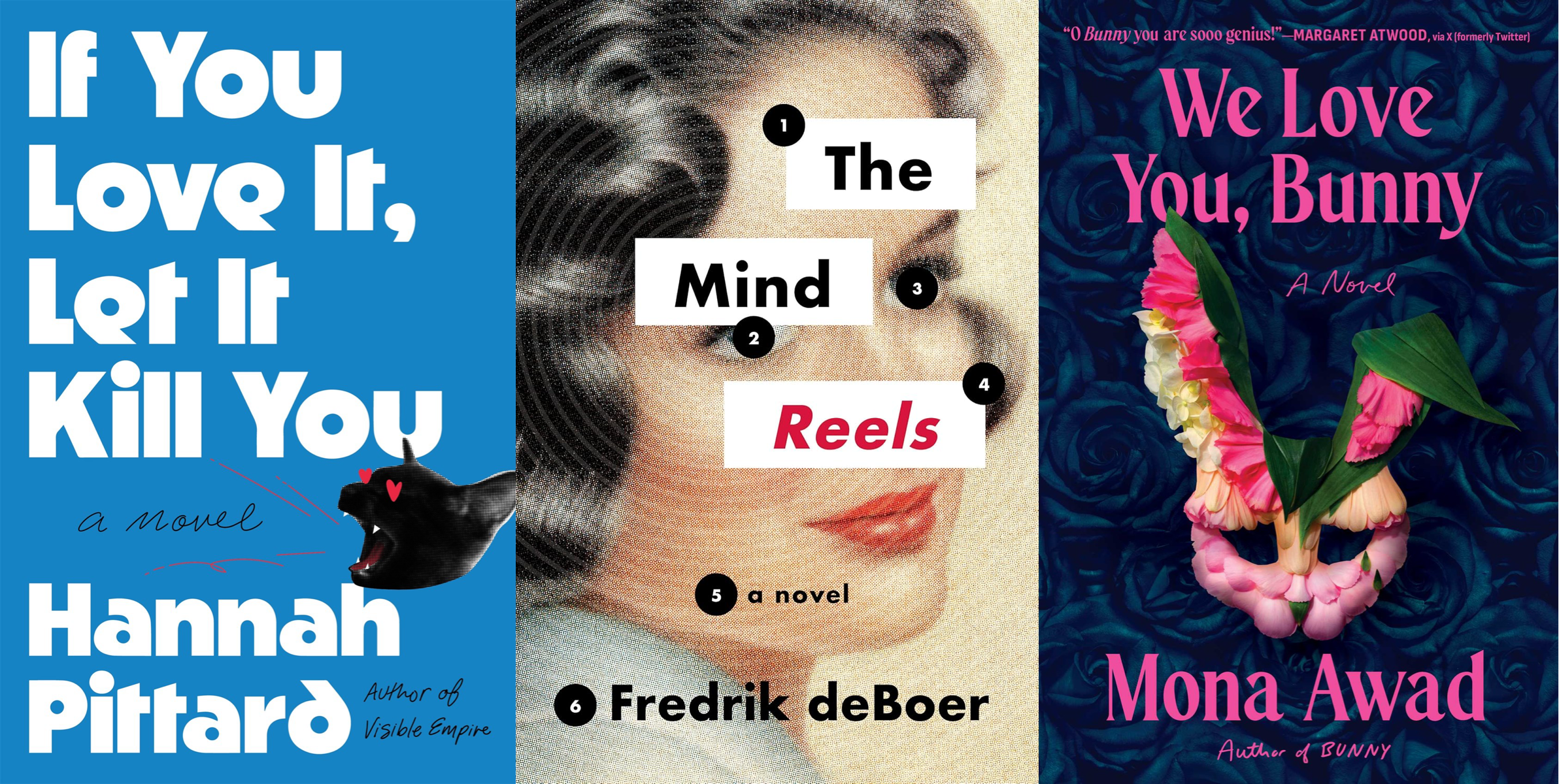
If You Love It, Let It Kill You
v. The Mind Reels
v. We Love You, Bunny
Judged by Spencer Williams
Spencer Williams is the author of TRANZ (Four Way Books, 2024) and the forthcoming poetry collection Dirt Talk (Four Way Books, 2027). She is currently a Ph.D. candidate in poetics at SUNY, Buffalo. Known connections to this year’s contenders: None.
What is the “state of the academy” in 2025? Words like panic, fear, malaise, dread, chaos, and all their lugubrious synonyms spring to mind as apt “state” descriptors, especially when I close my eyes inside my university office with no windows and pretend I’m floating in the world’s driest sensory deprivation tank. This lexicon of pessimism is no doubt a symptom of my current “occupation” as an English graduate student, which is to say: powerless in the face of departmental AI “experimentations” that suspiciously and inevitably frame ChatGPT as a “tool” students can use in our classrooms, and the stern gazes of my dissertation advisors when I tell them my chapter will be ready to read “next month.” And yet, for all my complaining, I chose this lifestyle. I love my colleagues. I love responding to student emails that begin with “Howdy” and “sup teach.” I love the vending machines all over campus that don’t take debit cards. And most of all, I love identifying and labeling the tension points between faculty members during department meetings. So naturally, I jumped at the chance to judge this play-in round on the current “state of the academy.” Who better to cast judgment upon three novels than someone who got their MFA in poetry?
As a former undergraduate at the University of Iowa, the world of Fredrik deBoer’s The Mind Reels, which follows a young woman navigating the trauma of undergraduate dorm room life, felt familiar to me. Google tells me that many Oklahomans consider themselves to be Midwestern, which leads me to believe life at the University of Oklahoma is similar to the life I once led in Iowa City, which is to say predominately defined by an acute and blisteringly untreated mental illness. For the most part, I identified with Alice, the novel’s protagonist, as she struggled to tightrope-walk the line between the cruel and naïve behaviors of others and herself. Her anxious need to get ahead of perceived or hypothetical social slights, enacting them before they could be enacted upon her, felt true to my experience of moving through college as a live, sparking wire. I was particularly captivated by how the novel balanced the constantly fluctuating stakes of Alice’s illness, particularly in moments when her feelings of apathy or horniness collided with her intrusive, violent thoughts:
He was attractive, the kind of boy she liked, angular and gangly, tall and soft. She felt moved to run her tongue down his belly and take his cock in her mouth, or perhaps to push a piece of broken glass into the soft space behind his left ear.
I appreciated these sharp psychological turns and, most of all, their fleetingness. Mental illness, for me, often feels like experiencing a smash cut, as on film, between one feeling and the next. Boom, a shattered window. Boom, a comforting field of grass.
FROM OUR SPONSOR

This is the part where I tell you how much I love my SSRI. Despite the weight gain and heightened chill, which makes meeting deadlines difficult, I no longer have to worry about being the kind of writer who lives inside a novel like Mona Awad’s We Love You, Bunny. I wonder if maybe I should have read We Love You, Bunny first, and if that reordering might have endeared me more to the playful villainy of the novel’s evil MFAers. As a formerly evil MFA student (evil, as in poet), I was waiting for a spark of recognition to move me beyond mild amusement. The inciting incident that leads the novel’s victim, Samantha, to be tied to a chair in an attic, surrounded by former peers out for her blood, is the publication of a novel barely disguising their names and characteristics. What Awad’s novel gets right is that, sometimes, the act of writing creatively feels like participating in a duel at high noon. Who gets the privilege of cementing a narrative about multiple people, especially when those people are also writers? As in The Mind Reels, this question illuminates the compulsive desire many (myself) share to get ahead of our perceived understanding of our own position in the narrative of others. Devoid of control, in what ways do we exist as minor characters, or as passing details, in the written lives of others? Scary stuff!
Despite my slight allergy to the campy, cartoon villainy of the novel’s protagonists, there are many funny and nerve-striking accuracies that made me feel seen in a way I wish I hadn’t. For example, when one character describes the agonizing fallout of a first feedback session, I was briefly transported back into the body of my younger, thin-skinned self, clutching crumpled pages desecrated with red pen scribbles and circles around my shamefully trite metaphors and descriptors (I am still guilty of these): “Allan handed me my story, covered in his many slashes. His letter in red pen on the back of the last page, which I did not read, would never fucking read.”
The anxiety that comes with being written about is also what drives Hannah Pittard’s novel If You Love It, Let It Kill You, a beautifully rendered account of a writer named Hana, who is also a teacher, grappling with her ex-husband’s recently published novel, which depicts her, in character form, being murdered with a knife. I was immediately taken with Hana’s thorny disposition, constantly wavering between neediness and aloofness, of being wanted and wanting to be left alone. I was also taken with the novel’s many classroom scenes, featuring unpredictable students brushing against the edge of her professional boundaries, which naturally result in her own shaky negotiations of those boundaries. In one interaction, Hana nervously tells a student “I feel like you’re both flirting with me and trying to put me in my place, which is absurd.” Absurd, indeed! I would spontaneously combust the moment these words left my mouth. And yet, I found Hana’s constant straining to always say and do the right thing, even when these attempts resulted in failure, to be deeply moving and humane. Whether it's on campus, or at home with a loved one, or at a bar with whoever, the writer self who observes and imagines must always contend with her other self, the one who must live with others, and speak, and articulate love not just on paper, but through action.
Across these novels, what I notice is how the academy serves as a container for various student and teacher neuroses, and how one’s worst self is often reflected in the kind of intellectual and linguistic work one must do to make sense of themselves and their place across many different structures: the familial, the institutional, the interpersonal. Therefore, there’s something in each of these novels that taps against my head and heart, reminding me to be cognizant of the person in front of me as much as the empty page. The one that tapped me the hardest, though, was Pittard’s If You Love It, Let It Kill You. The protagonist’s fallibility, clumsiness, and ultimate lovability, in both the classroom and bedroom, reminded me of many colleagues, and because I’m trying each day to be more and more earnest, myself. If you need it, this is a book to remind you that we’re all just searching for a pulse beyond the desk work, which, whether we enjoy it or not, will need to get done before final grades are due.
Advancing:
If You Love It, Let It Kill You
Match Commentary
with Andrew Womack, Rosecrans Baldwin, Meave Gallagher, and Alana Mohamed
Andrew Womack: Hello everyone, and welcome to the 2026 Tournament of Books, presented by Field Notes! Thank you all for being here, despite everything that’s going on out there, and thank you also to our Sustaining Members for making the 22nd year of this whole thing possible.
Rosecrans Baldwin: It’s true, true, true. Personally, I carry a Field Notes notebook with me everywhere I go, they’re the best. And yeah, like Andrew said: No Sustaining Members, no Tournament. At this point, our production calendar is about seven months long, and it’s thanks to our members’ support that we can make this happen. So, if you’re a Sustaining Member, thank you! And if you’re not one yet, please join in—it’s fun! (Plus, you’ll get 50 percent off all items in our store, including the new 2026 merch.)
Now, Meave, enough from us, please take it away.
Meave Gallagher: Welcome back, everyone: Alana, commentariat, Rosecrans, Andrew, John, Kevin. Alana, how are you feeling going into this year’s Tournament?
Alana Mohamed: Hello Meave, commentariat, and Tournament crew! I’m excited to get back into the book talk, though my own head feels quite empty. I read about half of the books that are up and already one of my faves has been knocked out.
Meave: Mona! I’ve read everything except the two I Could Not Deal With: The Buffalo Hunter Hunter, because right now I’m very sensitive about horror and Quan Barry’s novel was available first at the library; and The Passenger Seat, because the publisher’s description made it sound too much like “Funny Games in a car,” and I refuse to subject myself to a whole book that threatens to be about Young Men’s Spontaneous Acts of Nihilistic Violence. And yet I read The Mind Reels. Alana.
Alana: To be fair, you said nothing about avoiding an Older Man’s Calculated and Overwrought Act of Psychic Violence.
Meave: I’m shocked Judge Williams felt she could relate to Alice—that novel was one of the most misogynistic, hateful, cruel books ostensibly “about” mental illness I’ve ever read. No, strike everything after “books”; it was mean as hell, and Alice's psychosis seemed to me like an exercise in punishing a woman for 168 pages. Reading it made me feel like I was being shown revenge porn. Caveat: I have read no reviews and do not engage with deBoer’s writing, so I have no idea why he chose this subject matter or made his protagonist a woman; I'm just grateful the judge disposed of it quickly.
Alana: You know, at the start of The Mind Reels, the constant barrage of self-assessment and minimization felt familiar, but I was unsettled to see the narrator continue in this way. So, yes, I am glad to be rid of it, too. I thought If You Love It, Let It Kill You and We Love You, Bunny were a great matchup in many ways, but I am bummed We Love You, Bunny didn’t make it through!
Meave: As much as I enjoyed the weirder bits of If You Love It, Let It Kill You, I didn’t see it beating We Love You, Bunny. Mona Awad is always weird, and this novel read like she was having fun, too. The judge doesn’t say if she read the book’s predecessor, Bunny—I don’t know that you have to have read it in order to enjoy We Love You, Bunny, but it helps. Then again, I would fight for Mona Awad, so, biased! I loved spending more time in that world.
Alana: I confess I was ignorant of Mona Awad before this and I hadn’t read We Love You, Bunny, so I went in with no expectations. I think both Awad and Pittard were having fun with it—I especially liked the asides where Hana’s classroom becomes a kind of critical chorus—but We Love You, Bunny always kept me on my toes, and I, unlike our good judge, did kind of tire of Hana’s shtick after a while. I couldn’t tell if it was because I knew too many writers who reminded me of Hana or if it’s because Hana reminded me of a past version of myself.
Meave: Hana complains so much about her family having no boundaries, but for all her introspection, does she realize how porous her own boundaries are? I’d say no.
Alana: That Hana insists on the charm of her shenanigans is a little grating, though I guess that was the point. And to be fair it was very readable. I finished If You Love It, Let It Kill You in a day, while We Love You, Bunny took me longer to get through (I confused characters multiple times throughout the book).
Meave: I must commend the narrator of the We Love You, Bunny, audiobook, Sophie Amoss; she did incredible work. I did not get lost—I often got the giggles.
Alana: My attention span is too weak for audiobooks but I may give it a listen! I did think it was interesting that Judge Williams was “waiting for a spark of recognition” to take her beyond amusement with We Love You, Bunny, but also found it had “funny and nerve-striking accuracies that made me feel seen in a way I wish I hadn’t.” The book is kind of outrageous, and I can see how that might create distance, but I think it was just the bolder and weirder of the two.
Meave: I really like Mona Awad pushing her fractured fairy tales ever further. As far as finding “Hana’s constant straining to always say and do the right thing, even when these attempts resulted in failure, to be deeply moving and humane,” I might’ve agreed with Judge Williams if I hadn’t encountered such people in real life: They are unbearable. What about foisting a cat who’s been hit by a car onto an undergraduate is doing “the right thing?” Of course, 2025 was a cursed year in which my perfect and best beloved Jenny Linsky died of a very aggressive cancer, so I’m a billion times more sensitive to animal pain in media than usual.
Alana: Ugh, Meave, we will always remember Jenny Linsky fondly! I honestly was very rattled thinking of her hiding that injured cat away and not treating it immediately! But also, I almost kissed the ground when the cat started talking and something else was happening. I suppose it shows good taste on Pittard’s part that she knew then to zig (narratively, not pet care-wise).
Meave: Full agree, re: the talking cat shaking up the narrative.
And that concludes our play-in match! Monday is the official start of the opening round, with Judge Tomi Onabanjo presiding over Ian McEwan’s “sci-fi” climate change novel What We Can Know and Vijay Khurana’s young men at night in The Passenger Seat.
Today’s mascot

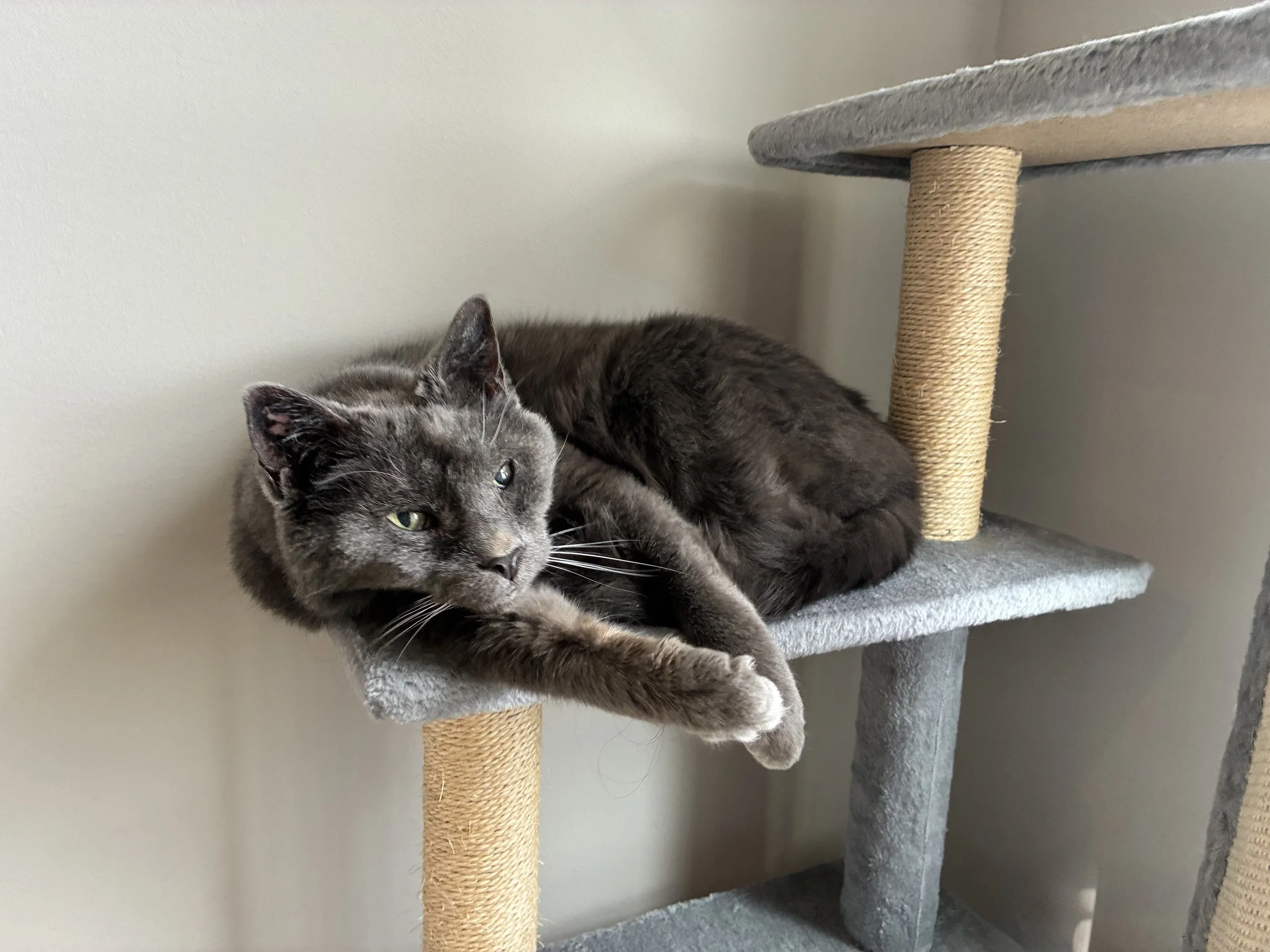
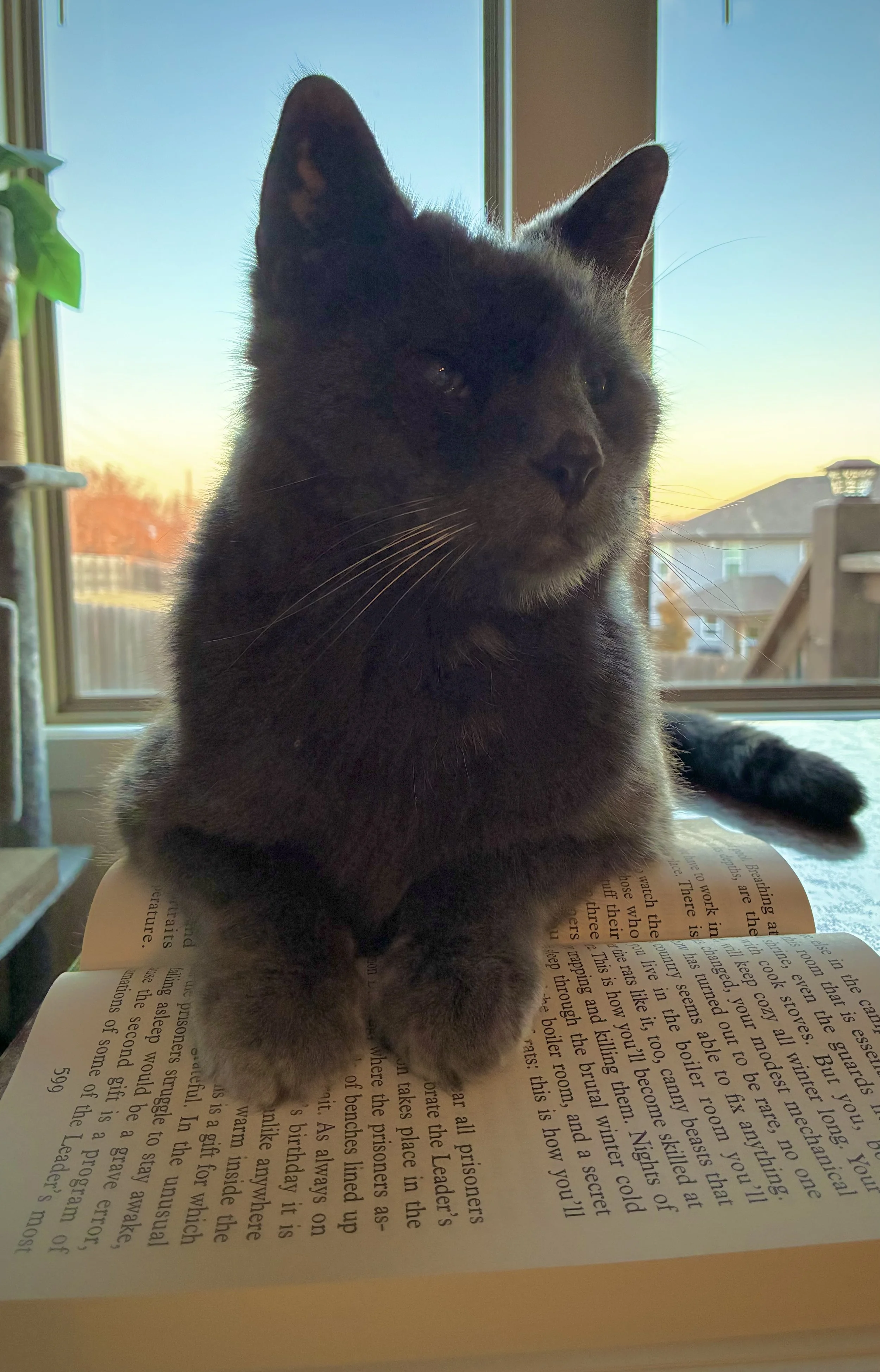
Nominated by Mark, meet Sir Lancelot—entitled, petulant, oblivious to house rules, and has been plotting escape for 13 years. His favorite books are Papillon and Lord of the Flies. Often makes use of annoying humans as pillows, a most excellent attribute. Might be the perfect housemate.
If you’re interested in nominating a pet as a mascot for this year’s Tournament of Books, contact us for more details. (Please note, this is a paid program.)